


Manang
Table of Contents
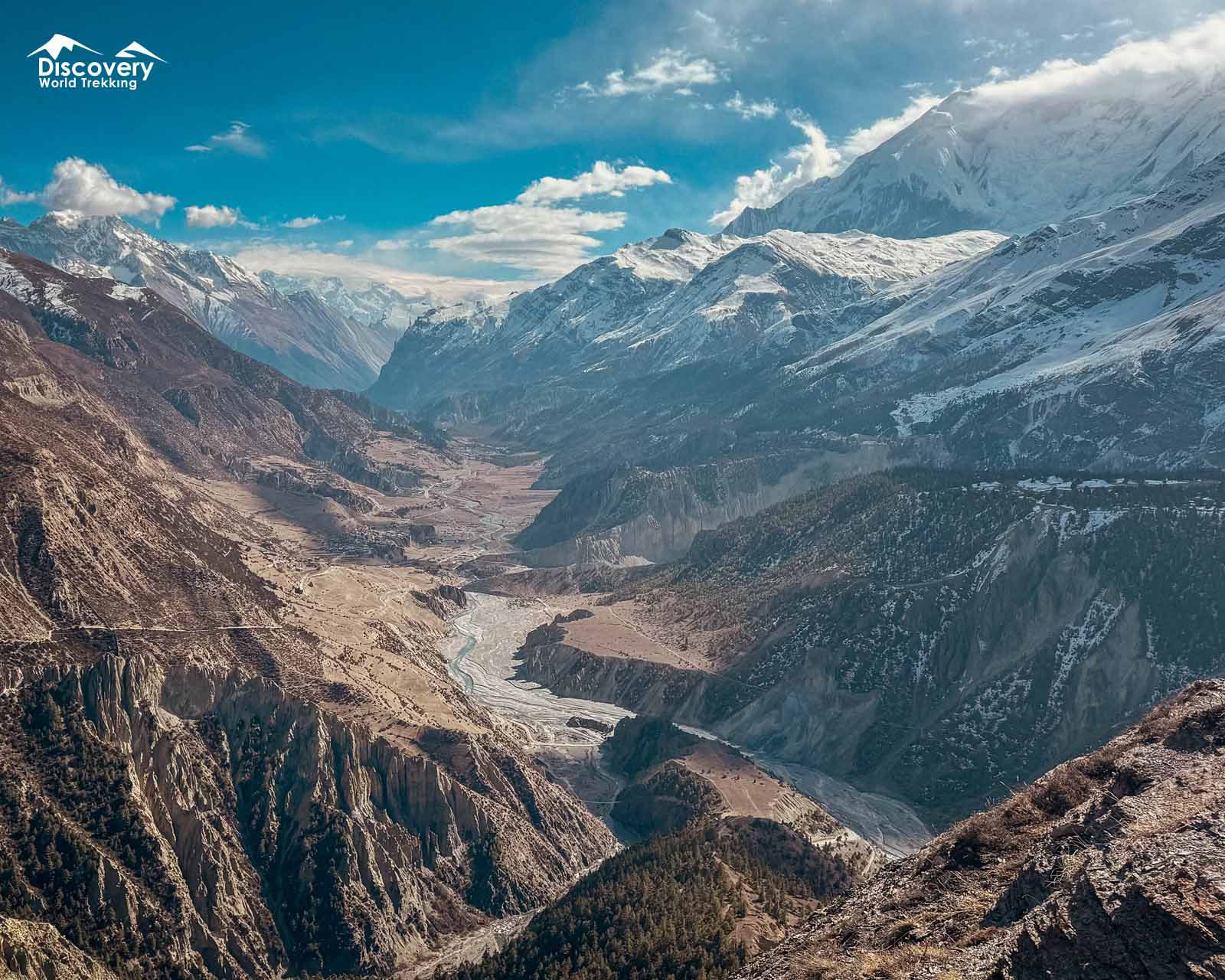
Manang sits in the trans-Himalayan rain shadow of the Annapurna range. The landscape is dry and open, with wide valleys, rocky slopes, and huge mountain views.
Most trekkers stop here to acclimatize before Thorong La Pass, but there is much more to Manang than a night of rest.
The village has monasteries, a museum, bakeries, a cinema hall, and several side trips, giving trekkers plenty of reasons to stay, explore, and take in the high-mountain setting.
Where Is Manang Located?
Manang is located at an altitude of 3,540 m (11,614 ft) in a broad glacial valley above the Marsyangdi River. It lies on the Annapurna Circuit between Pisang to the south and Thorong La Pass to the north.
Annapurna II (7,937 m / 26,040 ft), Annapurna III (7,555 m / 24,787 ft), and Gangapurna (7,455 m / 24,459 ft) all rise close to the village, and Tilicho Peak (7,134 m / 23,406 ft) is visible on clear days from several points around Manang.
| Province | Gandaki Province |
| District | Manang District |
| Region | Manang (Annapurna Circuit) |
| Elevation | 3,540 m (11,614 ft) |
| Latitude | 28.667° N |
| Longitude | 84.020° E |
Why Manang Is a Must-Visit on the Annapurna Circuit?
Manang has a way of turning a rest stop into one of the highlights of the Annapurna Circuit trek, with more to see, do, and recover in than almost anywhere else on the Circuit.
1. The Best-Equipped Village on the Upper Circuit
Manang has a health post, bakeries, a small cinema hall, and shops that smaller villages simply do not have.
That makes it a genuinely good place to rest properly, not just somewhere to pass through on the way up.
2. Gateway to the Best Side Trips
Gangapurna Lake, Ice Lake, Milarepa Cave, and the Tilicho Lake detour are all reached from Manang.
This is why most trekkers spend two nights here instead of one, using the extra day to fit in a hike or two before continuing toward Thorong La Pass.
3. A Rain Shadow Landscape Unlike Anywhere Else on the Circuit
Sitting behind the Annapurna range, Manang stays dry and open where most of the trail is forested and green.
Annapurna II, Annapurna III, Gangapurna, and Tilicho Peak are all visible from the village at once, framed by a landscape that looks closer to trans-Himalayan desert than typical Nepali hill country.
4. The Acclimatization Hub Before Thorong La Pass
Manang sits at the last major settlement before the trek's highest point.
Spending two nights here and using acclimatization hikes to higher elevations is one of the most effective ways to prepare the body for what comes next.
How to Reach Manang?
There's no reliable scheduled flight into Manang. A small airstrip exists at nearby Hongde (Humde), but commercial service is irregular, so almost everyone arrives by road or on foot.
By Road
Route: Kathmandu/Pokhara → Besisahar → Dharapani → Chame → Pisang → Manang
Kathmandu or Pokhara to Besisahar: A paved highway connects both cities to Besisahar, the standard gateway to the Annapurna region. From Kathmandu, this takes around 6 to 8 hours; from Pokhara, around 4 hours.
Besisahar to Manang: A rough mountain jeep road continues from Besisahar toward Manang. A direct jeep can cover the whole route in a single long day, though it is a bumpy 10 to 12-hour journey best suited to travellers who don't mind dust and switchbacks.
Many trekkers instead take a jeep only as far as Dharapani or Chame, then walk the rest, making the journey more manageable while also allowing time for acclimatization.
On Foot
Route: Pisang → Ghyaru → Ngawal → Manang (upper route) or Pisang → Humde → Braga → Manang (lower route)
From Pisang, the trail to Manang covers about 16 kilometres and takes 5 to 7 hours.
The upper route through Ghyaru and Ngawal is longer and climbs higher, but rewards the extra effort with some of the best mountain views on this stretch of the Circuit.
The lower route through Humde and Braga is more direct and slightly easier. Both routes converge before the final approach into Manang.
Along the way, look out for Paungda Danda, a sheer curved rock wall rising dramatically above the valley, one of the most striking sights on the walk in.
11 Places to Visit Around Manang
Let's have a look.
1. Chongkar Viewpoint
Chongkar sits at roughly 3,750 to 3,900 metres on a hilltop just above Manang, about 3 km from the village, reached in about 1.5 to 2 hours on a well-marked path.
It is one of the best acclimatization hikes from the village, and the view from the top takes in the Manang Valley, Gangapurna Lake, and the Gangapurna Glacier, with Annapurna III and Tilicho Peak completing the panorama.
2. Braka Monastery and Village
Braka (also spelled Braga), at around 3,470 metres, sits about 3 km from Manang and is one of the oldest settlements in the valley.
Its monastery is roughly 500 to 600 years old, built into the hillside, and remains an active part of village life rather than a museum piece.
The village itself is quieter and less crowded than Manang, with traditional stone houses and a slower pace.
3. Praken Monastery
Praken Gompa, also known locally as the 100 Lama Cave Monastery, is about 2 km from Manang and sits on a cliffside above the valley.
Visitors traditionally bring a small offering in exchange for a blessing from the resident lama, said to bring safety on the trek ahead.
The views from the monastery take in the wider valley and the surrounding peaks.
4. Milarepa Cave
Milarepa Cave sits at around 4,100 to 4,200 metres, about 5 km from Manang, just outside Braga village.
According to legend, the Tibetan saint and poet Milarepa meditated here in the 11th century, and the rock still bears impressions said to come from his meditation postures.
It is both a genuine pilgrimage site and a solid acclimatization hike, steep but not overly long.
5. Ice Lake
Ice Lake, known locally as Kicho Tal, sits at about 4,600 metres, roughly 12–16 km round trip from Manang.
The hike typically takes 6 to 8 hours and is one of the more demanding acclimatization outings from the village, but it is also one of the most rewarding, with a genuinely alpine lake, often frozen, set against Chulu East and Annapurna III.
There are actually two small lakes here, close together.
6. Gangapurna Lake and Glacier
Gangapurna Lake sits about 1.5 km from Manang, directly below the village, fed by the Gangapurna Glacier above it.
It is one of the easiest walks from Manang, a relatively flat round trip of about 2 hours, making it a popular first acclimatization outing.
The glacial lake reflects Annapurna IV, Gangapurna, and Tilicho Peak on a clear day.
7. Bhojo Gompa
Bhojo Gompa is about 2 km from Manang, a cliffside monastery reached by a steep hike above the village, taking about 1 to 1.5 hours each way. Along with panoramic views of Gangapurna Lake, Annapurna III, and the Marsyangdi Valley, it offers the same tradition of an offering in exchange for a blessing found at other monasteries in the area, making it as much a cultural stop as a scenic one.
8. Ngawal Village
Ngawal sits at around 3,660 metres, about 10 km from Manang, on flat terrain along the upper route between Pisang and Manang.
It is considered one of the best viewpoints in the region, with a wide, uninterrupted view of Annapurna II, III, and IV, along with Pisang Peak.
The village also has its own monastery, a Guru Rinpoche statue, and a cave above the settlement worth the short climb.
9. Manang Culture Museum
The Manang Culture Museum is located in the village and offers a closer look at the culture, traditions, and daily life of the Manangi people. Exhibits include traditional clothing, household items, tools, photographs, and objects linked to the region's Tibetan Buddhist heritage.
It is a small but worthwhile stop, especially for trekkers who want to understand the local culture and way of life beyond the mountains and trekking trails.
10. Old Manang Village (Tenki Manang)
Tenki (also spelled Tanki) Manang is about 1 km from the main village, the older, more traditional part of the settlement, distinct from the newer trekking lodges clustered around the main trail.
It is associated with Karki Gompa and Pocho Gompa nearby, and it retains a quieter, more lived-in character than the busier tourist-facing side of the village.
11. Khangsar
Khangsar sits at around 3,734 metres, roughly 5 km from Manang, and is the gateway village for the Tilicho Lake trek.
There are actually two settlements, Upper and Lower Khangsar, both with basic teahouses.
Tara Gompa sits near Upper Khangsar, and the village offers clear views of Annapurna II, Annapurna III, and Gangapurna.
8 Things to Do in Manang
Here are the eight best things to do in Manang.
1. Visit Apple Orchards
Manang's apple orchards, particularly around Bhratang, Bagarchhap, and Danaque on the trail below the village, are locally famous. Fuji and Golden varieties are common, and several farms let visitors taste apple cider, juice, and wine alongside the fresh fruit.
2. Paragliding
Paragliding is well established down in Pokhara, but it isn't a standard, reliably available activity in Manang itself. Given the altitude, wind conditions, and lack of dedicated operators in the village, treat this as a rare, weather-dependent option at best rather than something to plan around.
3. Mountain Biking
The Annapurna Circuit is also ridden as a mountain biking route by specialist operators, with Manang as a stop along the way. It's a serious undertaking given the altitude and terrain, generally suited to experienced riders on a dedicated biking itinerary rather than something arranged casually on the trail.
4. Enjoy Horse Racing Festival
Manang and the surrounding villages, including Braga, Khangsar, and Tenki Manang, celebrate Yartung, a horse racing festival usually held in July or August. It marks the return of horses from the high summer pastures after the harvest, and combines several days of monastery ceremonies, dancing, archery, and a final day of horse racing between village riders.
5. Explore Manang Village
Beyond the sights, simply walking through Manang's old lanes is worthwhile: mani walls, prayer wheels, stone houses with flat roofs used for drying grain, and a genuinely lived-in village rather than a purpose-built trekking stop.
6. Trek to Tilicho Lake
Tilicho Lake, at 4,919 metres, is one of the highest lakes in the world and a major side trip from Manang via Khangsar.
The round trip takes 3 to 4 days, crossing a notoriously landslide-prone section en route, and is considered moderate to strenuous. For trekkers with the extra time, it is widely regarded as one of the standout side trips on the entire Circuit.
7. Go to Projector Halls
Manang has a small cinema hall where mountaineering and adventure films are shown to trekkers in the evening, a simple but well-loved way to pass a rest day, especially given how limited evening entertainment is elsewhere on the trail.
8. Eat Fresh Pastries
Manang's bakeries are a genuine highlight for many trekkers, serving apple pie, fresh bread, and espresso, a small but real comfort after days of teahouse food further down the valley.
Popular Treks Passing Manang
- Annapurna Circuit Trek: The classic route around the Annapurna massif, with Manang as the key acclimatization stop before Thorong La Pass.
- Annapurna Circuit Trek with Tilicho Lake: The same route through Manang, extended with the side trip to Tilicho Lake via Khangsar.
When Is the Best Time to Visit Manang?
Manang can technically be visited most of the year, but spring and autumn are generally the best seasons for both weather and trail conditions.
Spring (March to May)
Spring brings milder temperatures to the trail as winter fades. March can still feel cool, especially on the walk up from Pisang, but April and May are generally warmer, making both the trek in and the acclimatization hikes around Manang more comfortable.
Rhododendrons and wildflowers bloom along the lower sections of the trail in spring. However, Manang itself is above the treeline, so the landscape remains dry and open.
Mornings tend to be clear, with clouds building later in the day as the season moves toward May, so early starts are worth it for hikes to Gangapurna Lake or Chongkar Viewpoint.
Autumn (September to November)
Autumn is generally considered the best season to visit Manang. The monsoon clears by mid-September, and combined with the village's rain shadow position, this is when the air feels driest and cleanest all year.
By October and November, days are typically dry and stable, with some of the clearest, most consistent views of Annapurna II, Annapurna III, and Gangapurna all year.
This is also when Manang is at its busiest, with trekkers filling teahouses before and after Thorong La Pass. Dashain and Tihar, Nepal's two biggest festivals, usually fall during this period too, adding a cultural layer to the village for anyone passing through during the celebrations.
Winter (December to February)
Winter brings real cold to Manang, with temperatures dropping well below freezing at night and far fewer trekkers on the trail. Thorong La Pass can become difficult or close entirely in heavy snow during this period, which limits how many trekkers continue beyond Manang.
Clear winter days can still deliver excellent visibility of the surrounding peaks, sometimes among the sharpest views of the year, but this is a demanding season to trek through and should be planned for accordingly.
Monsoon (June to August)
Manang's rain shadow position means it stays noticeably drier than most of Nepal during monsoon, making it one of the more genuinely viable places to visit in this season.
While lower, more exposed sections of the trail turn muddy and cloud-covered, Manang itself sees more broken cloud than the persistent grey further south.

Temperature in Manang
| Season | Daytime | Nighttime |
| Spring (Mar–May) | 8°C to 15°C (46°F to 59°F) | -5°C to 0°C (23°F to 32°F) |
| Autumn (Sep–Nov) | 8°C to 14°C (46°F to 57°F) | -6°C to -1°C (21°F to 30°F) |
| Winter (Dec–Feb) | -5°C to 5°C (23°F to 41°F) | -15°C to -8°C (5°F to 18°F) |
| Monsoon (Jun–Aug) | 12°C to 18°C (54°F to 64°F) | 2°C to 7°C (36°F to 45°F) |
Permits Required to Visit Manang
Two permits are required for the standard route through Manang, the same ones used for the rest of the Annapurna Circuit.
| Permit | Fee |
| Annapurna Conservation Area Permit (ACAP) | NPR 3,000 |
| TIMS Card (Trekkers' Information Management System) | NPR 2,000 |
People, Lifestyle, and Culture in Manang
Manang's people, often called Manangi or Nyeshangte, have a distinct identity shaped by centuries of relative isolation and historical trade with Tibet. Tibetan Buddhist traditions are central to local life, while older Bon and animist beliefs can still be seen in some customs. Hindu festivals are also observed, reflecting the area's mix of cultural influences.
Mani walls, chortens, and prayer flags are common throughout the village and along the trail. Monasteries at Braga, Praken, and Bhojo remain active religious sites. Festivals such as Yartung bring communities together through horse riding, traditional music, dancing, and feasting.
Traditional houses are built from stone and wood to withstand Manang's cold, dry winds. Many have flat roofs used for drying grain, firewood, and medicinal herbs. Livestock herding has long been part of life here, with families keeping yaks, sheep, and horses. Traditional crops include barley, buckwheat, potatoes, and other hardy crops suited to the high-altitude climate.
Marriage customs have traditionally involved family involvement, community gatherings, and Buddhist rituals, although practices are changing with modern life. Farming, livestock, apple cultivation, and trekking tourism support the local economy today.
Road access, migration, education, and growing tourism are also changing life in Manang. While these changes have brought better access and new economic opportunities, they are also influencing traditional lifestyles and customs.
History of Manang Village
For much of its history, Manang stayed isolated from the rest of Nepal. That isolation shaped a culture closer to Tibetan tradition on the other side of the range than to the customs found in most of the country.
Manangi traders built a strong regional reputation over generations. The first formal royal order granting them special trading privileges is usually dated to 1784, under King Rana Bahadur Shah, with Bahadur Shah acting as regent at the time.
Those privileges gave many Manangi families the freedom to build trading businesses well beyond the valley itself, a legacy that still shapes the district's reputation today.
Tourism reached Manang later than most other parts of Nepal. It arrived with the rise of the Annapurna Circuit as a trekking route in the latter half of the 20th century. Even then, change came slowly at first.
That's shifted more recently. Road construction from Besisahar up the Marsyangdi valley has steadily crept closer to Manang over the years. In many itineraries, this has cut the classic three-week trek down to as little as 7 to 10 days.
The road has changed how visitors reach the valley, how local families earn a living, and how much of the old rhythm of life survives alongside the new traffic. Even so, Manang has held onto much of its traditional character, particularly in the older quarter of Tenki Manang and in nearby villages like Braga.
Where to Stay in Manang?
Manang has a good range of accommodation, from simple teahouses and lodges to a few more comfortable hotels. Most trekkers stay in teahouses, which provide everything needed for a night or two while acclimatizing before continuing toward Thorong La Pass.
Teahouses and Lodges
Most trekkers stay in teahouses, and Manang has more of them, and better-equipped ones, than almost anywhere else on the upper Circuit.
You can expect twin-share rooms with basic furniture, blankets and pillows, and either shared or attached bathrooms depending on the lodge.
Hot showers and device charging are usually available for an extra fee, and Wi-Fi is common, though signal quality varies. A zero-degree sleeping bag is still worth carrying regardless of where you stay, given how cold nights get at this altitude.
Luxury Hotels
A small number of higher-end lodges in Manang offer more comfortable rooms, better heating, and more reliable hot water than standard teahouses, at a noticeably higher price.
These fill up quickly in peak season, so booking ahead through a trekking operator is worth doing if comfort is a priority.
Popular Foods in Manang
Dal bhat remains the standard, filling meal across the village, alongside noodle soup, momos, and thukpa. Manang's bakeries add something most other villages on the Circuit can't match: fresh bread, apple pie, and espresso, a genuine point of comfort this far into a high-altitude trek.
Local Himalayan foods are also worth trying. Tsampa, made from roasted barley flour, is a traditional staple often mixed with tea, water, or butter.
Dhido, a thick porridge made from buckwheat or millet flour, is commonly served with gundruk or vegetable curry. Gundruk is made from fermented leafy greens and is eaten as a side dish or in soup.
Churpi, a local cheese often made from yak milk, comes in both soft and hard varieties and may be smoked.
Yak meat is also used in dishes such as yak steak, yak momos, and yak burgers. Alu ken, a local Manang dish made with mashed potato and rice and flavoured with preserved yak fat, offers another taste of the valley's traditional food culture.
Yak butter tea and buckwheat bread reflect Manang's Tibetan-influenced food traditions. In autumn, dried apples and local cheese are also commonly available in the village.
What to Pack for Manang?
- Layered clothing: A base layer, insulating mid-layer, and windproof outer shell. Manang's dry, rain-shadow climate still swings sharply between day and night.
- Zero-degree sleeping bag: Teahouse blankets alone aren't enough at this altitude, even in the milder seasons.
- Sturdy, broken-in hiking boots: For both the trail in and the acclimatization hikes around the village.
- Sunglasses and high-SPF sunblock: Glare is intense at this altitude, especially on the open, treeless terrain around Manang.
- Cash in Nepali rupees: ATMs are unreliable this far up the valley, so carry enough for Manang and beyond.
- Basic first-aid kit: Including any altitude medication prescribed in advance by a doctor.
Is Manang Worth It?
Yes, Manang is worth it and not just as a place to rest. Manang combines genuine acclimatization value with more things to actually do than almost anywhere else on the Annapurna Circuit: monasteries, a museum, a glacial lake at the doorstep, and one of the best side trips in Nepal at Tilicho Lake, all set against a rain-shadow landscape that looks like nowhere else on the trek.
It still demands respect. The altitude is real, and the point of stopping here is preparation for what comes next at Thorong La Pass, not just sightseeing.
But for trekkers who take the extra day seriously and use it well, Manang tends to become one of the most memorable stops on the whole Circuit.
FAQs
How high is Manang Village?
Manang sits at approximately 3,540 metres (11,614 feet) above sea level.
Can I visit alone in Manang?
You can visit Manang as part of an independent itinerary, but since April 2023, trekking in Nepal's conservation areas, including the Annapurna region, requires a licensed guide. Fully independent, guideless trekking is no longer permitted.
How many days should I spend in Manang?
Most itineraries include two nights in Manang for acclimatization. Trekkers wanting to add Tilicho Lake should plan for an additional 3 to 4 days round trip.
Is there an ATM in Manang?
ATM access this far up the valley is unreliable at best. It is recommended to carry enough Nepali rupees from Besisahar or Chame to cover Manang and the rest of the trek.
Plan Smarter, Trek Better
Connect with our local expert for honest recommendations, personalised guidance, and insider tips to make every step of your adventure count.

Get our free Nepal travel guide filled with expert insights, local tips, and essential planning advice.