


Dharapani
Table of Contents
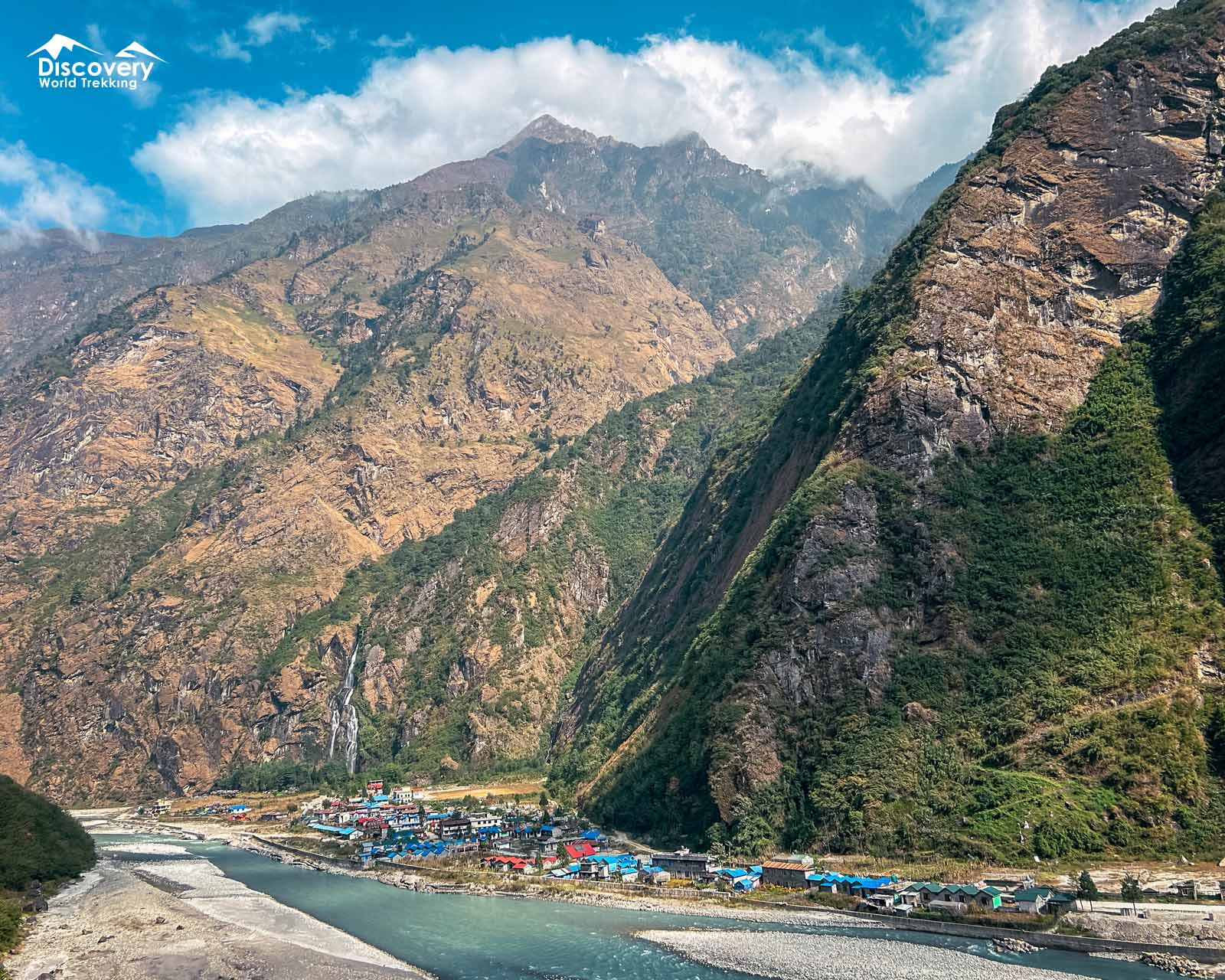
Dharapani is a small trading village in Manang District, located along the route connecting the Manaslu and Annapurna Circuit trekking regions. It lies on the banks of the Marsyangdi River, surrounded by forested hillsides and terraced fields.
For trekkers completing the Manaslu Circuit, Dharapani marks the end of the trail after crossing Larkya La Pass, while for Annapurna Circuit trekkers, it serves as a common entry point toward Chame, Manang, and Thorong La Pass.
The name Dharapani comes from the Nepali words dhara, meaning a natural spring or water spout, and pani, meaning water. The name reflects the importance of natural water sources in this mountain settlement, where reliable water was essential for travellers moving through the valley.
Where Is Dharapani Located?
Dharapani is located in Manang District, Gandaki Province, in central-northern Nepal. It lies within Nashong Rural Municipality along the Marsyangdi River, on the route connecting the lower Marsyangdi Valley with the higher Manang region.
The village sits between Bagarchhap and Chame and serves as an important junction for trekkers. The Annapurna Circuit continues north from Dharapani toward Chame, Manang, and Thorong La Pass, while the Manaslu Circuit traditionally ends here after the descent from Larkya La Pass.
Dharapani also lies within the Annapurna Conservation Area and near the transition from the Manaslu trekking region into the Annapurna region.
| Province | Gandaki Province |
| District | Manang District |
| Municipality | Nashong Rural Municipality |
| Region | Annapurna Region, Marsyangdi Valley |
| Elevation | 1,860 m / 6,102 ft |
| River | Marsyangdi River |
| Latitude | 28.5178° N |
| Longitude | 84.3584° E |
| Conservation Area | Annapurna Conservation Area |
How to Reach Dharapani?
There is no airport in Dharapani, so the village is reached by road or on foot. Most trekkers arrive from Besisahar, while those completing the Manaslu Circuit reach Dharapani on foot after crossing Larkya La Pass.
By Road
Kathmandu to Dharapani via Besisahar
Route: Kathmandu → Besisahar → Dharapani
From Kathmandu, Besisahar is about 190 km away and takes around 6–7 hours by road. From Besisahar, the remaining 35 km to Dharapani follows a rough mountain road and takes around 3–4 hours by local jeep.
Pokhara to Dharapani via Besisahar
Route: Pokhara → Besisahar → Dharapani
From Pokhara, Besisahar is around 110 km and takes approximately 5–6 hours, followed by another 3–4 hours by jeep to Dharapani.
On Foot
Trekkers completing the Manaslu Circuit reach Dharapani on foot after crossing Larkya La Pass. The trail descends through Bimthang and Tilije before reaching Dharapani.
Route: Larkya La Pass → Bimthang → Tilije → Dharapani
Distance: Approximately 25–30 km, Time: 1–2 days
After crossing the pass, the trail descends through alpine terrain and forested valleys before reaching Dharapani. From here, trekkers can take a jeep toward Besisahar or continue along the Annapurna Circuit.
Permits
Permit requirements depend on the route and nationality. Annapurna Circuit trekkers generally need an ACAP permit, while Manaslu Circuit trekkers require the Manaslu Restricted Area Permit and conservation-area permits.
Permits are normally arranged in Kathmandu, Pokhara, or through a registered trekking agency.
| Permit / Registration | Cost |
| Annapurna Conservation Area Permit (ACAP) | NPR 3,000 |
| TIMS Card (Trekkers' Information Management System) | NPR 2,000 |
| Manaslu Conservation Area Permit (MCAP) | NPR 3,000* |
Best Time to Visit Dharapani
Dharapani can technically be reached year-round, but spring and autumn are the two seasons that offer the most reliable weather and trail conditions.
Spring (March to May)
Spring brings warmer daytime temperatures to the Marsyangdi Valley as winter fades. March can still feel cool, especially in the mornings, but April and May are generally milder, making the walk in and out of the village more comfortable.
This is also when the rhododendron forests around Dharapani come into bloom, turning the hillsides shades of red and pink along the approach from Bagarchhap.
Mornings tend to offer the clearest views of Lamjung Himal and Annapurna II, with cloud building up later in the day, particularly closer to May.
Spring is one of the two busiest seasons for both the Manaslu and Annapurna Circuits, so Dharapani sees a steady flow of trekkers arriving from both directions.
The season also coincides with Holi in March, which adds a festive atmosphere to the villages along the route.
Autumn (September to November)
Autumn is generally considered the best season to pass through Dharapani. The monsoon clears by mid-September, leaving the trail greener and the air noticeably cleaner heading into October.
By October and November, days are typically dry and stable, with some of the clearest mountain views of the year.
This is when peaks like Annapurna II, Manaslu, and Cheo Himal are most likely to stay visible for days at a stretch rather than clouding over by afternoon.
This is also peak trekking season, so expect Dharapani's teahouses to be busier, especially with trekkers finishing the Manaslu Circuit and others heading north toward Chame.
Dashain and Tihar, Nepal's two biggest festivals, usually fall during this period, adding a cultural layer to the village for anyone passing through.
Winter (December to February)
Winter is quiet in Dharapani, with far fewer trekkers passing through and a noticeably calmer pace at the teahouses.
Mornings and nights turn cold, but because Dharapani sits at a comparatively low 1,860 metres, it stays milder than the high passes on either side and rarely sees serious snowfall itself.
Larkya La and Thorong La, the passes on the Manaslu and Annapurna sides, close or become difficult in heavy snow during this period, which limits through-traffic.
Trekkers using Dharapani as a base for shorter walks in the surrounding valley will still find clear, cold days with good visibility.
Monsoon (June to August)
Monsoon brings the heaviest rainfall of the year to the Marsyangdi Valley. Days are warm and humid, with spells of heavy rain broken up by occasional clear stretches, and cloud cover regularly hides the surrounding peaks for days at a time.
The valley turns a deep green during these months, and the forest sections around the village feel genuinely lush.
The trade-off is mud, leeches on the lower trail, and a higher risk of landslides on the road between Besisahar and Dharapani, which is why most trekkers avoid this season despite the scenery.

Popular Treks Passing Through Dharapani
Dharapani is an important stop on several trekking routes offered by Discovery World Trekking, including variations of the Annapurna Circuit and the Manaslu Circuit.
Annapurna Circuit Trek: The standard Annapurna Circuit itinerary reaches Dharapani on Day 3, after trekking from Jagat. From Dharapani, the route continues toward Chame, Pisang, Manang, and Thorong La Pass before descending toward Mustang.
Annapurna Circuit Trek with Tilicho Lake: This extended version of the Annapurna Circuit also passes through Dharapani before continuing toward Chame and Manang. The itinerary adds a side trip to Tilicho Lake, one of the world's highest lakes, before rejoining the main Annapurna Circuit route toward Thorong La Pass.
Manaslu Circuit Trek – 12 Days: The 12-day Manaslu itinerary reaches Dharapani after the Larkya La section of the trek. From here, trekkers continue through the Marsyangdi Valley toward Besisahar, completing the circuit.
Annapurna Circuit Short Trek – 10 Days: This short Annapurna Circuit itinerary passes through Dharapani on Day 2 during the drive from Besisahar to Chame. The bus stops at Dharapani for permit registration before continuing toward Chame, making it an important entry point to the Annapurna trekking region.
Lifestyle, Culture, and Religion in Dharapani
The population around Dharapani is a mix of Gurung and Tibetan-influenced communities, along with smaller numbers of other Himalayan ethnic groups like Magar.
Daily life still centres on farming the terraced fields around the village and running the teahouses that serve trekkers passing through.
Buddhism shapes much of what visitors notice first: prayer flags strung between houses, mani walls built from carved stone, and a small village monastery where locals gather for regular ceremonies.
Passing a mani wall or chorten on the correct side, keeping it to your right, is a small courtesy trekkers are expected to follow, as it is throughout the wider region.
Traditional stone houses with timber-framed windows are still common in the older part of the village, built in a style shared with other settlements along the upper Marsyangdi Valley.
Because Dharapani sits at the point where Manaslu's more strongly Tibetan-influenced culture gives way to the Gurung and mixed Himalayan character of the Annapurna region, trekkers walking through from either direction notice the shift in architecture, dress, and daily routine.
Flora and Wildlife in Dharapani
At 1,860 metres, Dharapani sits in the transition zone between subtropical and temperate forest, part of the wider Annapurna Conservation Area.
The hillsides around the village are covered in oak, pine, and rhododendron, with the rhododendron forests turning shades of red and pink each spring.
Wildlife sightings here tend to be more about birds than mammals. The cliffs above Dharapani are a nesting habitat for vultures, easily watched from the trail below.
The surrounding forest is also home to laughingthrushes, treepies, and occasionally the spiny babbler, a bird found only in Nepal.
Higher on the ridgelines, pheasant species become more common. Mammals are less frequently seen but include langurs and musk deer, with occasional reports of Himalayan black bear in the denser forest patches.
Things to Do in Dharapani
Here are some of the things you can do in Dharapani:
- Visit the village monastery and prayer sites: A small monastery and several prayer areas sit within the village, where visitors can watch daily Buddhist rituals and see prayer flags and offerings up close.
- Walk along the Marsyangdi River: The river runs right past the village, with clear views of Lamjung Himal, Annapurna II, Manaslu, and Cheo Himal from various points along the bank. It is a natural stop for photography before continuing to higher elevation.
- Watch birds and local wildlife: The forested slopes around Dharapani offer opportunities for birdwatching. Carry binoculars if you are interested in birds, and avoid disturbing wildlife or entering forest areas alone.
- Experience local culture: Observe the Gurung and Tibetan-influenced traditions, try local food at a teahouse, and speak with residents about village life. Festivals and community ceremonies can be particularly rewarding when your visit coincides with one.
- Cross the suspension bridge: A metal suspension bridge over a stream near the village is a common stop for photos, and it also offers a good look at the valley below.
Where to Stay in Dharapani?
Dharapani has around 10 to 15 teahouses, lodges, and guesthouses, enough to comfortably handle both Manaslu and Annapurna trekkers passing through.
Rooms are simple: a bed, sometimes a shared bathroom down the hall, though a handful of lodges offer private rooms with attached bathrooms at a higher rate.
Basic twin-sharing rooms typically run $3 to $6 a night, with private or better-equipped rooms costing $6 to $10.
Prices tend to rise slightly during the busiest weeks of spring and autumn, and staying at the same lodge where you eat your meals is a common way to get a better overall rate.
Popular places to stay in Dharapani include Hotel Manaslu View, Annapurna Guesthouse, Hotel Gurkha’s Inn, Gorkha’s Inn, Three Sisters, Manaslu Lodge, and Annapurna Lodge, most of which offer simple rooms, meals, and basic facilities for trekkers.
Booking ahead is not usually necessary outside peak season, but during October and November, arriving early in the day or reserving a room in advance helps avoid arriving at a full lodge.
Facilities in Dharapani
Dharapani has basic but adequate facilities for trekkers. Electricity is generally available, although individual lodges may experience outages or rely partly on solar power.
Some teahouses provide Wi-Fi, but the connection is usually slow and may incur an additional charge. Phone and camera charging is available at many lodges, commonly for a separate fee.
Hot showers are offered by several lodges, usually using gas or solar heating, but availability is not guaranteed and may cost extra.
There is no dependable ATM service in Dharapani or the surrounding villages, so trekkers should carry enough Nepali rupees in advance. Nepal Telecom often provides the more reliable signal, although both Nepal Telecom and Ncell coverage can be intermittent.
Popular Foods in Dharapani
Teahouse menus in Dharapani follow the same pattern found across the Annapurna and Manaslu regions.
Dal bhat, rice, lentils, and vegetables, often with a spiced side dish, is the standard meal and the most filling option for a trekking day.
Noodle soup and momo (steamed dumplings) are common alternatives, alongside Tibetan bread served with honey or jam.
For trekkers wanting something closer to home, most lodges also serve pasta, fried rice, and omelettes.
Pancakes are a common breakfast item. Hot drinks, tea, coffee, and hot chocolate are available everywhere and worth having in the cooler evenings.
What Equipment Do You Need to Trek to Dharapani?
What you pack depends on which direction you are heading next, since Dharapani itself sits at a relatively mild elevation but connects to much higher terrain in both directions. The essential equipment for the trek to Dharapani includes:
- Layered clothing: A moisture-wicking base layer, a warm mid-layer, and a windproof or waterproof outer shell, since temperatures shift quickly between daytime walking and evening cold.
- A warm sleeping bag: Lodges have limited heating, and nights get cold even though Dharapani sits lower than the passes ahead.
- Sturdy trekking boots: Broken in before the trip, given the uneven trail surfaces along the Marsyangdi Valley.
- A headlamp and a fully charged power bank: Electricity is limited and charging often comes with a fee.
- Water purification tablets or a filter: Use a water filter or purification tablets to treat tap or stream water before drinking. Carrying a reusable water bottle also makes it easier to refill along the trail.
- Basic first-aid supplies: Including altitude sickness medication, since this leg of the trail sits below the passes you're likely heading toward next.
- Sun protection: Sunglasses and sunscreen, since UV exposure is stronger at altitude even on cooler days.
- Cash in Nepali rupees: Enough to cover several days, since there are no ATMs in or around Dharapani.
FAQs
How high is Dharapani?
Dharapani sits at 1,860 metres (6,102 feet) above sea level.
Is Dharapani part of the Annapurna Circuit or the Manaslu Circuit?
Both. It is the point where the two treks meet, the finishing point for most Manaslu Circuit trekkers, and a common starting or joining point for the Annapurna Circuit.
How many days should I plan to spend in Dharapani?
Most trekkers spend a single night here, using it as a rest stop before continuing toward Chame and Manang, or exiting to Besisahar after completing the Manaslu Circuit.
Are there ATMs in Dharapani?
No. There are no ATMs in Dharapani or in the surrounding villages, so trekkers need to carry enough cash from Kathmandu or Pokhara.
Are there medical facilities in Dharapani?
Only basic first aid at some lodges; there is no hospital or clinic. Serious medical issues require evacuation to Chame or Besisahar.
Do I need a permit to pass through Dharapani?
Yes. An ACAP permit and TIMS card are checked at the village checkpoint, and Manaslu trekkers register here when exiting the Manaslu Conservation Area.
Plan Smarter, Trek Better
Connect with our local expert for honest recommendations, personalised guidance, and insider tips to make every step of your adventure count.


Get our free Nepal travel guide filled with expert insights, local tips, and essential planning advice.