


Ghorepani
Table of Contents
Ghorepani is a high mountain village in Nepal’s Annapurna region and the main overnight stop for travellers heading to Poon Hill.
The name Gorepani comes from the Nepali words ghora or ghode (horse) and pani (water), meaning “horse water.”
Historically, the village served as a rest and watering stop for horse and mule caravans on old Himalayan trade routes between the lowlands, the Kali Gandaki valley, and the trans-Himalayan region.
Where Is Ghorepani Located?
Ghorepani sits in Myagdi District, Gandaki Province, within the Annapurna Conservation Area, on a mountain pass between two forested ridges. It lies southeast of the Dhaulagiri range, with the Annapurna and Dhaulagiri massifs forming the wider Himalayan setting.
The village is split into two parts: Lower Ghorepani, where permits are often checked, and Upper Ghorepani, where most of the lodges are clustered.
The village stands on a forested ridge between the main trekking routes from Nayapul and Tatopani, with trails continuing toward Tadapani, Ghandruk, and other Annapurna destinations. Historically, Ghorepani also served as a stop along the old Tibetan Salt Trade Route.
The village is approximately 65 kilometres from Pokhara by the usual road-and-trail approach.
| Country | Nepal |
| Province | Gandaki Province |
| District | Myagdi District |
| Region | Annapurna Conservation Area |
| Elevation | 2,874 m (9,429 ft) |
| Coordinates (approx.) | 28°23′50″N, 83°41′50″E (≈ 28.397°N, 83.697°E) |
| Nearby villages | Ulleri, Deurali, Tadapani, Ghandruk |
What Is Ghorepani Famous For?
Ghorepani may be a small mountain village, but its location and surroundings make it one of the most popular stops in the Annapurna region. It is best known for:
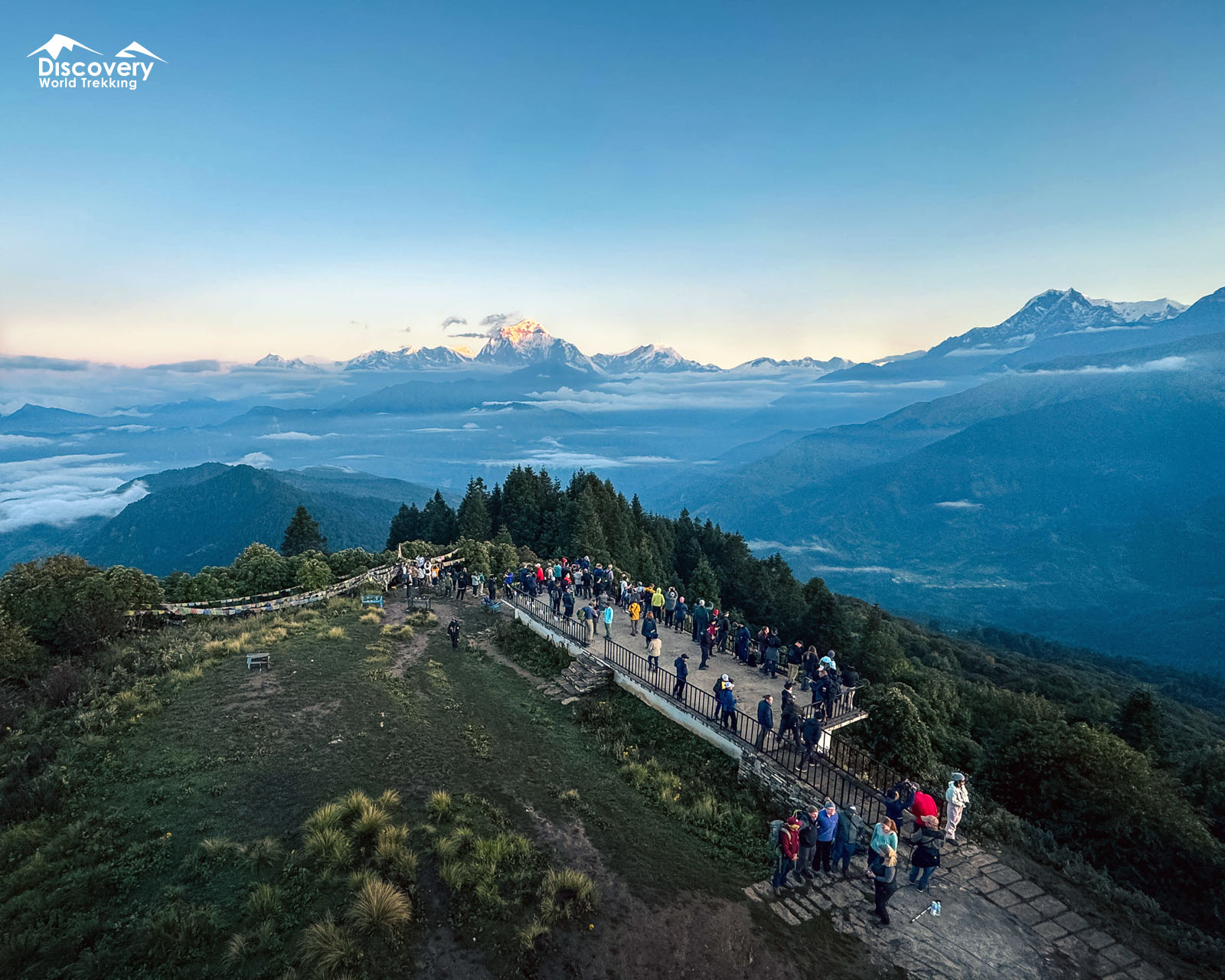
- Gateway to Poon Hill, Nepal's Most Accessible Sunrise Viewpoint
Ghorepani is famous first and foremost as the base for Poon Hill, a 45-minute pre-dawn climb away.
Few sunrise viewpoints in Nepal combine this much reward with this little effort, which is exactly why Poon Hill has become one of the country's most photographed spots.
- Panoramic Himalayan Views: Annapurna, Dhaulagiri & Beyond
Clear weather from Ghorepani and Poon Hill can reveal several major peaks in the Annapurna and Dhaulagiri ranges.
The most prominent views include Dhaulagiri I, Annapurna I, Annapurna South, Machhapuchhre, Hiunchuli, Nilgiri, and Tukuche Peak.
- Blooming Rhododendron Forests, Best in Spring (March–May)
Ghorepani is surrounded by one of Nepal’s largest continuous rhododendron forests, mixed with oak and other temperate species.
From March to May, the hillsides burst into shades of red as the rhododendrons bloom, creating a striking “red forest” effect.
Common species include Rhododendron arboreum, Nepal’s national flower, known for its red blooms; R. barbatum, with deep red to pink flowers; and R. campanulatum, which produces soft pink or white flowers at higher elevations.
- Magar (Pun) Cultural Heartland
Magar communities have long lived in the hills around Ghorepani. Many local families operate teahouses, lodges, shops, and transport services for trekkers.
Visitors can observe traditional farming, household life, local food customs, and mountain hospitality. The communities are also associated with the wider Gurkha tradition, although Ghorepani itself should be understood first as a living village rather than a staged cultural attraction.
How to Reach Ghorepani?
Ghorepani can be reached from several directions, with most routes combining a drive from Pokhara with a walk through mountain villages and forests.
The best route depends on your time and trekking preference.
-
Classic Route: Pokhara → Nayapul → Trek to Ghorepani (via Ulleri)
There is no direct road into Ghorepani itself. Every route to the village involves at least some walking, whether that is a full multi-day trek from Nayapul or a shorter hike after driving as far as the road allows.
Route: Pokhara → Nayapul → Tikhedhunga → Ulleri → Ghorepani
From Pokhara, it is about a 1- to 1.5-hour drive to Nayapul, where the trek begins.
The trail follows the Modi Khola valley through Tikhedhunga before the famous climb to Ulleri, a stretch of more than 3,000 stone steps that's widely considered the toughest single section of the whole trek.
From Ulleri, a further 2 to 3 hours of walking through rhododendron and oak forest brings you to Ghorepani. The full walk from Nayapul takes 5 to 7 hours.
-
Jeep Option: Pokhara → Ulleri or Banthanti → Short Trek to Ghorepani
Route: Pokhara → Ulleri or Banthanti (by jeep) → Ghorepani (on foot)
During dry seasons, a rough jeep track extends as far as Ulleri or Banthanti, cutting out the lower section of the walk, including most of those 3,000 steps.
From either point, the remaining trek to Ghorepani takes roughly 2 to 4 hours, a popular option for trekkers short on time or keen to avoid the steepest climbing.
-
Alternative Approach: Via Tatopani (Less Common, Scenic)
Route: Pokhara → Beni → Tatopani → Ghorepani
A jeep or local bus covers the road from Pokhara to Tatopani via Beni in roughly 7 to 8 hours.
From Tatopani, the trek up to Ghorepani follows the same trail used by Annapurna Circuit trekkers descending in the other direction, climbing steadily through Sikha and Chitre before reaching Deurali and the village itself.
-
From Ghandruk or Tadapani: Popular Multi-Day Loop Routes
Many trekkers reach Ghorepani as part of a loop rather than an out-and-back trip, walking in via Ghandruk and Tadapani (roughly 5 to 6 hours) and continuing on to Poon Hill before descending a different way, or vice versa.
This is one of the most popular short circuits in the entire Annapurna region.
Major Mountains Visible From Ghorepani and Poon Hill
- Annapurna I (8,091 metres): Annapurna I is the highest peak in the Annapurna massif and one of the world’s highest mountains. From Poon Hill, it forms part of the wider north-facing Himalayan panorama.
- Dhaulagiri I (8,167 metres): Dhaulagiri I is the dominant peak to the west and often the most striking mountain visible from Poon Hill. Its broad, high massif can appear especially clear in the early morning.
- Annapurna South (7,219 metres): Annapurna South is prominent in the southern section of the Annapurna range. Its broad snow-covered slopes are visible from several points around Ghorepani and along the trail toward Tadapani.
- Machhapuchhre Fishtail (6,993 metres): Machhapuchhre, meaning “Fishtail,” is recognisable for its twin summit profile. The mountain is culturally significant and is regarded as sacred, so climbing it is prohibited.
- Hiunchuli (6,441 metres): Hiunchuli rises near Annapurna South and is commonly visible from viewpoints along the Poon Hill and Ghandruk routes.
- Nilgiri (7,061 metres): Nilgiri is part of the Nilgiri massif north of the Annapurna region. Its pale, sharply defined slopes can be visible in clear conditions from Poon Hill.
- Tukuche Peak (6,920 metres): Tukuche Peak stands in the Dhaulagiri area and appears among the peaks west of the viewpoint.
Things to Do in Ghorepani
Most activities in Ghorepani involve walking, photography, nature observation, and cultural interaction.
You do not need technical mountaineering skills for the standard routes.
1. Hike to Poon Hill for Sunrise, The Iconic 1.5-Hour Climb
Leave Ghorepani before sunrise and follow the marked uphill trail to Poon Hill. The climb usually takes about 45 minutes to 1.5 hours, followed by a shorter descent back to the village.
The trail is steep in places and can be busy. A headlamp is essential because the route is dark before dawn.
2. Wander Through Ghorepani’s Stone Trails and Traditional Teahouses
A walk around the village provides a closer view of its stone paths, lodges, small shops, and mountain settlement pattern. It is also a good way to adjust to the altitude before the early start for Poon Hill.
But it is recommended to avoid entering private courtyards or photographing residents without permission.
3. Walk Amid Blooming Rhododendron Forests
Spring is the best season for seeing rhododendrons in flower. The most colourful sections are generally found along the forest trails between Ulleri, Banthanti, Ghorepani, and Tadapani.
Flowers are not guaranteed at every trail section, since blooming varies with elevation and weather.
4. Capture Himalayan Panoramas
Poon Hill is the main photography location, but the village and approach trails also provide useful foregrounds of stone houses, forest, terraces, and prayer flags.
And for sunrise photography, make sure to protect batteries from the cold and carry a lens cloth for mist or light rain. A tripod can be useful but adds weight on the trail.
5. Experience Magar Culture
Local interaction is usually informal: eating in family-run teahouses, learning about village life, and observing farming or household routines.
Some lodges also offer local dishes, cultural performances, or festival-related activities, but availability varies.
6. Relax at Teahouses
Evenings in Ghorepani are usually spent in communal dining rooms with tea, hot meals, books, cards, and conversations with other trekkers.
Many lodges have a stove or heater in the dining area, although warmth and fuel availability vary.
Trekkers mainly gather around it to charge phones, share route tips, and plan the next day’s start time for Poon Hill with their guide.
Nearby Attractions and Side Trips From Ghorepani
Ghorepani is more than a stop on the Poon Hill route, with several nearby trails leading to scenic viewpoints, traditional villages, and quieter parts of the Annapurna region.
These include Tadapani, Ghandruk, Khopra Ridge, and Deurali Pass.
1. Tadapani: Forested Ridge Village with Machhapuchhre Views
Tadapani is known for its forested trails and views toward Machhapuchhre and Annapurna South.
The trail from Ghorepani to Tadapani usually takes around 5–7 hours, depending on the route and walking pace.
Some shorter sections or nearby points may be described locally as three to four hours, but a full Ghorepani–Tadapani day normally requires more time.
2. Ghandruk: Cultural Gurung Village
Ghandruk is a major Gurung settlement with traditional houses, lodges, mountain views, and a local museum.
It is also one of the practical places to learn more about Gurung culture.
From Ghorepani, the village lies roughly 18–22 km away by trail, usually reached via Tadapani.
From Tadapani, the descent to Ghandruk usually takes around 3–4 hours, while the complete Ghorepani–Tadapani–Ghandruk journey is normally completed over two days.
3. Khopra Ridge: Off-the-Beaten-Path Panorama
Khopra Ridge, also called Khopra Danda, is a quieter high-ridge route reached through several days of trekking.
Simply a round trip from the Ghorepani area, generally requiring about 2–3 days or more.
The route has fewer facilities than the main Poon Hill trail.
Trekkers are recommended to plan accommodation, food, weather protection, and navigation carefully.
4. Deurali Pass: High Ridge Trail
Deurali is a forested ridge and pass on routes linking Ghorepani with Tadapani. The walking distance from Ghorepani to Deurali is roughly 4–6 km one way.
The walking time varies by the exact trail section, but it is often around 2–3 hours one way from nearby Ghorepani-area settlements.
The trail is a useful alternative for trekkers who want to spend more time in the forest and avoid returning along the same path.
Best Time to Visit Ghorepani
Ghorepani is best visited in spring and autumn, when the weather is generally clear and the trails offer good mountain visibility.
Spring (March to May)
Spring brings warmer daytime temperatures to Ghorepani as winter fades.
March can still feel cool at the pre-dawn Poon Hill viewpoint, but April and May are generally milder, making both the climb up from Ulleri and the morning hike to the summit more comfortable.
This is also when the rhododendron forests around Ghorepani come into full bloom, turning the hillsides between Ulleri and the village shades of red and pink.
More than eight rhododendron species grow in this stretch of forest alone, and late March into April is typically the peak.
Mornings tend to offer the clearest views of Annapurna I and Dhaulagiri from Poon Hill, with cloud building up later in the day.
Autumn (September to November)
Autumn is generally considered the best season to visit Ghorepani.
The monsoon clears by mid-September, leaving the trail greener and the air noticeably cleaner heading into October.
By October and November, days are typically dry and stable, with some of the clearest mountain views of the year.
This is when Annapurna I and Dhaulagiri are most likely to stay fully visible from Poon Hill for days at a stretch, rather than clouding over by mid-morning.
Dashain and Tihar, Nepal's two biggest festivals, usually fall during this period too, adding a cultural layer to the villages.
Winter (December to February)
Winter is quiet in Ghorepani, with far fewer trekkers on the trail and a noticeably calmer pace at the teahouses.
Mornings turn genuinely cold, especially on the pre-dawn walk up to Poon Hill, sometimes dropping below freezing at the summit.
Because Ghorepani sits under 3,000 metres, it avoids the heavy snow and pass closures that affect higher routes.
What winter does deliver is more reliably than any other season, is haze-free air, often producing some of the sharpest, clearest views of Annapurna and Dhaulagiri all year.
Monsoon (June to August)
Monsoon brings the heaviest rainfall of the year to Ghorepani. Days are warm and humid, with frequent spells of heavy rain and occasional clear periods. Cloud cover often blocks views of Annapurna and Dhaulagiri from Poon Hill for several days.
The forests become deep green during these months, with the rhododendron and oak trees around the village looking especially lush.
| Season | Daytime | Nighttime |
| Spring (Mar–May) | 12°C to 20°C (54°F to 68°F) | 2°C to 8°C (36°F to 46°F) |
| Autumn (Sep–Nov) | 10°C to 18°C (50°F to 64°F) | 0°C to 6°C (32°F to 43°F) |
| Winter (Dec–Feb) | 2°C to 10°C (36°F to 50°F) | -5°C to 0°C (23°F to 32°F) |
| Monsoon (Jun–Aug) | 15°C to 22°C (59°F to 72°F) | 10°C to 15°C (50°F to 59°F) |
Lifestyle, Culture and Religion in Ghorepani
Ghorepani is a working mountain settlement as well as a trekking destination.
Tourism supports many households, but farming, livestock, seasonal labour, and family networks remain part of local life.
Steep land limits large-scale farming, so households often rely on terraced cultivation, livestock, tourism, and income from family members working elsewhere.
Tourism has expanded employment in lodging, guiding, portering, transport, and supply services.
Magar families are particularly associated with Ghorepani, while Gurung communities are prominent in nearby villages such as Ghandruk and Tadapani.
Both groups have distinct histories, languages, customs, and local identities.
Hindu and Buddhist practices coexist across the Annapurna hills. Prayer flags, shrines, temple traditions, household rituals, and seasonal festivals may be seen along the trails and in villages.
Older houses commonly use local stone, timber, and slate or metal roofing. Newer lodges may use concrete, painted walls, and modern plumbing while retaining some traditional materials.
Local Festivals and Customs
Ghorepani does not have a single, well-known festival unique only to the village. Instead, local life follows the broader Nepali and Himalayan festival calendar.
Dashain and Tihar are widely observed in Nepal, while Losar is important among several Himalayan communities.
Local celebrations may include family gatherings, religious rituals, music, dancing, and special food.
Flora and Wildlife Around Ghorepani
The forests and surrounding hills of Ghorepani are rich in Himalayan biodiversity, offering trekkers opportunities to see colorful rhododendrons, oak forests, native wildlife, and a variety of high-altitude birds.
Rhododendron and Oak Forests: Protected Biodiversity
Rhododendron, oak, pine, and mixed broadleaf forests cover much of the approach to Ghorepani.
Rhododendron is Nepal's national flower and is the most visible seasonal feature in spring, with about 8 species blooming along the Ghorepani trails between March and May.
In Ghorepani, you can find rhododendron flowers in shades of deep red, pink, and white.
Common Wildlife: Langur Monkeys, Musk Deer, Himalayan Tahr
Langur monkeys are a relatively common sighting in the forest sections of the trail.
Musk deer and Himalayan tahr are also found in the wider conservation area, although they are less frequently spotted around the village.
Birds Found Around Ghorepani: Danphe, Blood Pheasant, Eagles
The forests support many Himalayan bird species, including the Himalayan monal, known locally as Danphe, blood pheasant, eagles, vultures, and smaller forest birds.
A pair of binoculars and a quiet walking pace improve the chance of sightings. Bird activity is often highest in the morning.
Popular Treks Passing Through Ghorepani
- Ghorepani Poon Hill Trek: A 5-day route built entirely around Ghorepani and the Poon Hill sunrise, looping through Tadapani and Ghandruk.
- Poon Hill Trek: A shorter 4-day version covering the same core route for trekkers with less time.
- Annapurna Base Camp Trek: Some itineraries route through Ghorepani and Poon Hill on the way to the Annapurna Sanctuary, combining the sunrise viewpoint with the deeper trek to base camp.
- Annapurna Circuit Trek: Certain Circuit itineraries finish by descending from Tatopani through Ghorepani and Poon Hill before returning to Pokhara via Nayapul.
Where to Stay in Ghorepani
Ghorepani has a dense strip of teahouses and lodges along the main trail, offering twin-bed rooms, shared or attached bathrooms, and basic amenities like hot showers, Wi-Fi, and device charging.

Types of Rooms and Facilities
Room style: Most lodges have simple wooden or brick rooms with two single beds, foam mattresses, blankets, and a small table or shelf; some properties also have hall-style dorm rooms with multiple beds, mainly used by larger trekking groups.
Heated beds: A few higher-end lodges in Ghorepani offer electric blankets or heated bedding on request (often for an extra charge and subject to power availability), while most standard rooms remain unheated.
Bathrooms: The majority of rooms use shared toilets (a mix of Western and squat) in the hallway; some premium lodges provide attached bathrooms with Western toilets, especially for guests booking private rooms.
Hot showers: Available at most Ghorepani teahouses for an extra fee (roughly NPR 300–500 per shower), typically gas- or solar-heated; in colder months, hot water may be limited to bucket showers.
Electricity and charging: Rooms have lights and power outlets; many lodges charge NPR 200–300 to charge phones/cameras, though some include this for guests eating all meals on-site.
Wi-Fi and mobile data: Paid Wi-Fi cards or lodge Wi-Fi (around NPR 250–300) are common or sometimes free; Ncell and Nepal Telecom signals are generally available, but speeds are best for messaging and light browsing.
Typical Costs
Twin room (basic teahouse): About USD 3–6 (roughly NPR 500–1,000) per night; prices often drop or rooms become free if you take breakfast and dinner at the same lodge.
Private/attached-bathroom rooms: Slightly higher, often in the USD 8–15 range depending on the lodge and season.
Extra services: Hot shower NPR 300–500, Wi-Fi NPR 250–300, device charging NPR 200–300 (sometimes waived for full-board guests).
Food and Drinks in Ghorepani
Ghorepani’s teahouses serve hearty, carb-heavy trekking menus built around Nepali staples, Tibetan snacks, and simple Western dishes, with hot drinks and safe water options at every lodge.
What to Eat in Ghorepani
Dal bhat set: The most common lunch and dinner option, with rice, lentil soup, vegetable curry, pickle, and greens. Most lodges offer unlimited rice refills, making it a filling choice for trekkers.
Momos: Steamed or fried dumplings filled with vegetables, cheese, or minced meat. They are popular as an evening snack or light meal.
Noodle and rice dishes: Chow mein, fried rice, thukpa, and simple pasta are widely available. These are quick, filling options after a day of trekking.
Breakfast staples: Common choices include porridge, Tibetan bread, chapati, pancakes, toast, and eggs prepared in different styles.
Comfort foods: Garlic soup, vegetable curry, Nepali-style pizza, and apple pie are also available at many lodges.
Vegetarian options are abundant, and most menus can accommodate basic vegan requests (e.g., dal bhat without ghee, egg-free pancakes).
Drinks and Hydration
Hot drinks: Black tea, milk tea (chiya), ginger tea, lemon tea, coffee, and hot chocolate are common at lodges. They are especially popular after an early Poon Hill sunrise.
Soft drinks: Bottled Coca-Cola, Sprite, and Fanta are available at most lodges in Ghorepani. Prices are usually higher than in the lower villages because supplies have to be carried up the trail.
Alcohol: Local beers such as Everest, Gorkha, and Tuborg are available at some lodges. You may also find raksi made from rhododendron flowers. It is best to limit alcohol while trekking, as it can contribute to dehydration and affect sleep.
Water: Boiled or filtered water is available for refills at teahouses.
Permits Required to Visit Ghorepani
| Permit | Cost |
| Annapurna Conservation Area Permit (ACAP) | NPR 3,000 |
The ACAP is checked at designated trail checkpoints, including Birethanti near the start of the classic route. The permit is arranged through a registered trekking agency before the trek.
How Difficult Is the Trek to Ghorepani?
The trek to Ghorepani is rated easy to moderate, making it one of the more accessible multi-day treks in Nepal. No technical skills are required, and the route is well marked.
The main challenge is the climb to Ulleri, which includes more than 3,000 stone steps. Most days involve around 4 to 7 hours of walking.
Ghorepani sits below 3,000 metres, while Poon Hill is only slightly higher. This makes altitude sickness a lower risk than on higher Himalayan treks. However, staying hydrated and maintaining a steady pace are still important.
What to Pack for Ghorepani?
Packing for Ghorepani is mainly about preparing for changing temperatures, stone-paved climbs, and an early-morning hike to Poon Hill. Packing includes:
- Clothing: Layered clothing, a down jacket for cold mornings at Poon Hill, a rain shell, and a thermal base layer for early starts.
- Footwear: Broken-in trekking boots for the stone steps and forest trail, plus camp shoes or sandals to rest your feet at the teahouse in the evening.
- Trekking & Safety Essentials: A headlamp for the pre-dawn Poon Hill climb, water purification tablets or a filter, a basic first-aid kit, and sunscreen for the exposed viewpoint.
- Other Useful Items: A power bank, camera, snacks for the trail, cash in Nepali rupees, and copies of your permits.
Is Ghorepani Worth It?
Yes, Ghorepani is worth visiting. Ghorepani delivers a genuine Himalayan sunrise experience, real mountain views, and rhododendron forest, all within a short, accessible trek that does not demand technical skill or extreme fitness.
It won't offer the scale or altitude of Everest Base Camp or the Annapurna Circuit, and it isn't trying to.
What Ghorepani offers is efficiency. You get mountain views, local culture, forests, and a spectacular sunrise in a short trek. It is a practical choice for beginners, families, and travellers with limited time.
FAQ
What is the altitude of Ghorepani?
Ghorepani sits at approximately 2,874 metres (9,429 feet) above sea level.
Why is Ghorepani called the base of Poon Hill?
Ghorepani is the closest village and overnight base for the Poon Hill sunrise viewpoint. It sits just below the viewpoint and provides easy access for the early-morning climb. Most trekkers stay in Ghorepani the night before their Poon Hill sunrise hike.
How far is Poon Hill from Ghorepani?
Poon Hill is about 3 kilometres from Ghorepani, with around 336 metres of elevation gain. The hike usually takes 45 minutes to 1.5 hours, depending on your pace.
Plan Smarter, Trek Better
Connect with our local expert for honest recommendations, personalised guidance, and insider tips to make every step of your adventure count.


Get our free Nepal travel guide filled with expert insights, local tips, and essential planning advice.