Mardi Himal Trek - 5 Days

Mardi Himal Trek - 5 Days Overview

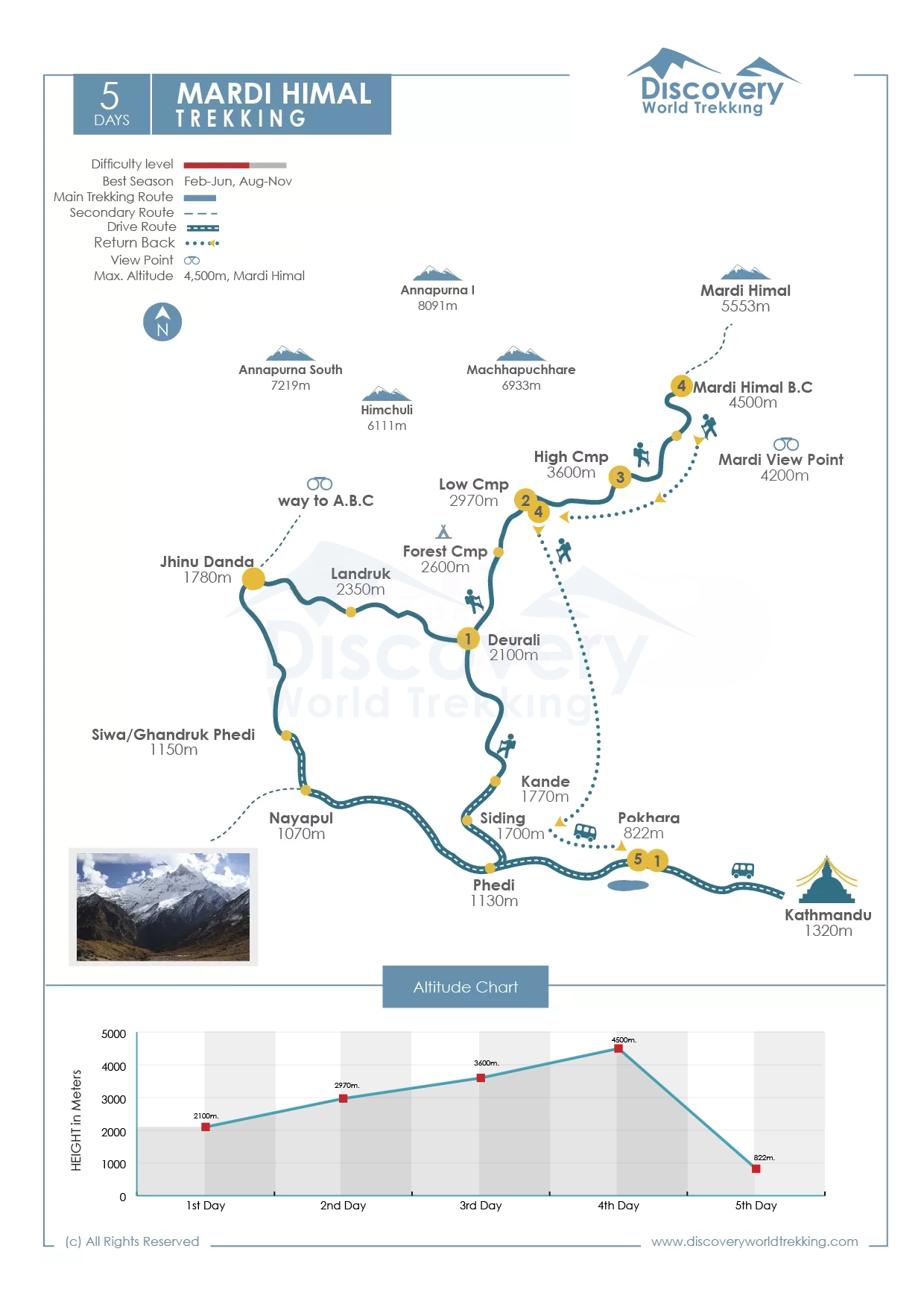
The 5-day Mardi Himal Trek winds through the scenic Annapurna region, passing lush rhododendron forests, traditional mountain villages, and rugged alpine ridges. The journey follows quiet hillside trails and open mountain terrain towards Mardi Himal Base Camp (4,500 m / 14,764 ft), offering beautiful close-up views of Machhapuchhre, Annapurna South, and Hiunchuli.

DestinationNepal
GradeModerate
Start / end pointKathmandu/ Kathmandu
AccommodationHotel in Pokhara and Hotel/Lodge/ Tea House during the trek
Best seasonFeb, Mar, Apri, May, June, Sep, Oct, Nov
Meals includedBreakfast in Pokhara Hotel and all Meals (Breakfast, Lunch, Dinner) during the trek
ActivityAnnapurna Treks
Max. altitude4500m Mardi Himal Base Camp

Mardi Himal Trek Highlights

  • Enjoy panoramic views of the Annapurna range from Australian Camp.
  • Walk through traditional villages and peaceful hillside communities.
  • Explore dense rhododendron, oak, and maple forests.
  • Pass through Forest Camp and Low Camp on quiet woodland trails.
  • Experience landscapes that range from lush forests to alpine ridges.
  • Stay at High Camp (3,600 m / 11,811 ft), surrounded by Himalayan scenery.
  • Trek along the narrow mountain ridge towards Mardi Himal Viewpoint.
  • Reach Mardi Himal Base Camp (4,500 m / 14,764 ft), close to the towering peaks.
  • Enjoy close-up sunrise views of Machhapuchhre, Annapurna South, and Hiunchuli.
  • Descend through the quieter village surroundings of Siding before returning to Pokhara.

Mardi Himal Trek Overview

The journey begins with a short drive from Pokhara to Kande, where you start walking toward Australian Camp. The trail passes through stone steps, green hills, and small settlements before reaching Pitam Deurali (2,100 m / 6,890 ft). From here, you can enjoy beautiful views of the surrounding hills and mountains.

Leaving Pitam Deurali, the trail gradually enters dense forests of oak, maple, and rhododendron. The peaceful woodland path winds through shaded sections and natural clearings before reaching Forest Camp (2,550 m / 8,366 ft).

Then you continue uphill through thick forests towards Low Camp (2,970 m / 9,744 ft). As you gain altitude, the trees gradually thin out, revealing occasional views of Machhapuchhre (Fishtail) and the surrounding Annapurna range.

The next section takes you from Low Camp to High Camp (3,600 m / 11,811 ft). The landscape changes from thick woodland to open alpine terrain, with narrow ridges and increasingly impressive mountain views. 

The trek's highlight is the early-morning ascent from High Camp to Mardi Himal Viewpoint (4,200 m / 13,780 ft) and Mardi Himal Base Camp (4,500 m / 14,764 ft). The ridge trail offers breathtaking views of Machhapuchhre, Annapurna South, and Hiunchuli. 

At Base Camp, the first rays of sun on Machhapuchhre turn it golden, offering the best view you can get. The mixture of cold air, the warmth of the morning sun, and a cup of hot tea is best when you are closest to the towering mountain landscape. You then retrace your route down to Low Camp.

On the final day, the trail descends through forested hills toward Siding village (1,700 m / 5,577 ft). This quieter village provides a glimpse of traditional rural life in the Annapurna region. 

From Siding, a two-hour drive brings you back to Pokhara, marking the end of your Mardi Himal adventure.


Short Itinerary

Day 1

Drive from Pokhara to Kande. Trek from Kande to Australian Camp to Pitam Deurali (2,100 m / 6,890 ft). Drive Time: Approx.1 hour. Trek Time: Approx. 4 hours.

Day 2

Trek from Pitam Deurali to Forest Camp to Low Camp (2,970 m / 9,744 ft). Trek Time: Approx. 6 hours.

Day 3

Trek from Low Camp to High Camp (3,600 m / 11,811 ft). Trek Time: Approx. 5 hours.

Day 4

Trek from High Camp to Mardi View Point (4,200 m / 13,780 ft) to Mardi Himal Base Camp (4,500 m / 14,764 ft). Return to Low Camp (2,970 m / 9,744 ft). Trek Time: Approx. 7 hours.

Day 5

Trek from Low Camp to Siding (1,700 m / 5,577 ft). Trek Time: Approx. 5 hours. Drive from Siding to Pokhara. Drive Time: Approx. 2 hours.

Are you looking to customise the trip itinerary?

If the published schedule does not suit you, we can build the trek around your dates, your pace and what you want to see.

Planning your trek schedule
Select Departure Date

The calendar below displays the available trek schedules. Please select the exact trek start date. Ensure your arrival day is before the trek start date and your departure day is after the trek end date.

Trip duration5 days
Trip Start and End PointKathmandu/ Kathmandu
December 2026
Su
Mo
Tu
We
Th
Fr
Sa
Su
Mo
Tu
We
Th
Fr
Sa
Sold out dates
Today

The price per person depends on your group size.
You choose it at the last booking step.

Select a start date to continue.

Continue booking

Mardi Himal Trek Video

Mardi Himal Trek Itinerary

Day 1of 5

Drive from Pokhara (822 m / 2,697 ft) to Kande (1,770 m / 5,807 ft). Trek to Pitam Deurali (2,100 m / 6,889 ft).

Driving Distance28 km / 17.4 miles
Driving Hours1 - 1.5 hours
Trek Distance5.5 km / 3.4 miles
Trek Duration3 - 4 hours

Your Mardi Himal Trek begins with a short drive from Pokhara to Kande, where you start trekking on foot. From here, you follow a stone-paved trail through hillside settlements and terraced fields toward Pitam Deurali.

Pokhara → Kande → Australian Base Camp → Pitam Deurali

The trail gradually rises through green hills and forested sections before reaching Australian Base Camp (2,060 m / 6,759 ft). This popular hilltop stop, locally called Thulo Kharka, offers beautiful views of the Annapurna range, Machhapuchhre (Fishtail), and surrounding valleys.

After a short break, you continue along the forested trail toward Pitam Deurali (2,100 m / 6,889 ft). The route passes through peaceful woodland and small communities, with occasional views of the mountains.

You reach Pitam Deurali, a quiet resting point surrounded by green hills. You spend the night at a teahouse before continuing on the higher forest trails the following day.

Overnight stay at Super Top View (room with attached bathroom)
Included standard meal (Breakfast)
Day 2of 5

Trek from Pitam Deurali (2,100 m / 6,889 ft) to Low Camp (2,970 m / 9,745 ft)

Trek Distance11.7 km / 7.27 miles
Highest Altitude2,970 m / 9,745 ft
Trek Duration5 - 7 hours

Today, you leave Pitam Deurali and head deeper into the forested section of the Mardi Himal route. The trail gradually rises through oak, maple, and rhododendron forests toward Low Camp.

Pitam Deurali → Forest Camp → Low Camp

The first section passes through dense woodland, where tall trees and shaded paths create a peaceful trekking environment. You follow a gradual uphill trail through the forest before reaching Forest Camp (2,550 m / 8,366 ft), a small resting settlement surrounded by thick vegetation.

From Forest Camp, the trail continues uphill toward Low Camp (2,970 m / 9,744 ft). As you gain altitude, the forest gradually becomes thinner, and occasional openings reveal views of Machhapuchhre and the Annapurna range.

You arrive at Low Camp, where the surroundings begin to open up. You stay overnight at a teahouse, preparing for the trek toward High Camp.

Overnight stay at hotel Moonlight
Included meals (Breakfast + Lunch + Dinner)
Day 3of 5

Trek from Low Camp (2,970 m / 9,745 ft) to High Camp (3600 m / 11,811 ft).

Trek Distance5.5 km / 3.4 miles
Highest Altitude3600 m / 11,811 ft
Trek Duration4 - 5 hours

Today, you continue ascending from Low Camp toward High Camp, following one of the most scenic sections of the Mardi Himal Trek. The trail gradually leaves the dense forest behind as you move toward open mountain terrain.

Low Camp → Badal Danda → High Camp

The route ascends along a narrow hillside ridge with increasingly open views of Machhapuchhre, Annapurna South, and Hiunchuli. You pass through sections of rhododendron vegetation before reaching Badal Danda (3,210 m / 10,531 ft), a scenic resting point over the clouds known for its wide mountain views.

Beyond Badal Danda, the trail becomes more exposed as you approach High Camp. The surrounding landscape changes into open alpine terrain, with grassy slopes and dramatic mountain scenery.

You reach High Camp (3,600 m / 11,811 ft), your overnight stop before the early morning hike to Mardi Himal Viewpoint and Base Camp. On a clear day, you can enjoy impressive views of the surrounding Himalayan peaks from the teahouse area.

Overnight stay at Hotel Fishtail
Included meals (Breakfast + Lunch + Dinner)
Day 4of 5

Trek from High Camp (3600 m / 11,811 ft) to Mardi Viewpoint (4,200 m/ 13,780 ft) to Mardi Himal Base Camp (4,500 m / 14,764 ft). Return to Low Camp (2,970 m / 9,745 ft).

Trek Distance15.5 km / 9.6 miles
Highest Altitude4,500 m / 14,764 ft
Trek Duration7 - 9 hours

Today is the highlight of your Mardi Himal Trek. You start early from High Camp and follow a narrow mountain ridge toward Mardi Himal Viewpoint and Mardi Himal Base Camp.

High Camp → Mardi Himal Viewpoint → Mardi Himal Base Camp → Low Camp

You continue uphill trek along an exposed ridge, offering spectacular views of Machhapuchhre, Annapurna South, and Hiunchuli. As you gain elevation, you trek through rugged terrain with open alpine slopes. You reach Mardi Himal Viewpoint (4,200 m / 13,780 ft), where the mountain panorama becomes even more dramatic. 

From here, you continue toward Mardi Himal Base Camp (4,500 m / 14,764 ft), the highest point of your trek. The closer views of Machhapuchhre and the surrounding Annapurna peaks make this the most memorable part of the journey.

After spending some time enjoying the mountain scenery, you retrace your route downhill toward Low Camp. The descent takes you back along the ridge and through the forested sections to Low Camp, where you stay overnight at a teahouse.

Overnight stay at Hotel Moonlight
Included meals (Breakfast + Lunch + Dinner)
Day 5of 5

Trek from Low Camp (2,970 m / 9,745 ft) to Siding (1,700 m / 5,577 ft). Drive to Pokhara (822 m / 2,697 ft).

Trek Distance6 km / 3.7 miles
Trek Duration7 - 9 hours
Driving Distance35 km / 21.7 miles
Driving Time2.5 - 3.5 hours

Today is the final day of your Mardi Himal Trek. After breakfast, you leave Low Camp and descend through forested trails toward Siding village, where you reconnect with the traditional rural landscape of the Annapurna region.

Low Camp → Siding → Pokhara

The trail takes you through dense forests, terraced hillsides, and small villages. As you lose elevation, the surroundings become greener and warmer. You eventually reach Siding (1,700 m / 5,577 ft), a traditional village with a peaceful hillside setting.

From Siding, you take a vehicle for the approximately two-hour drive back to Pokhara. Upon arrival, your 5-day Mardi Himal Trek comes to an end, leaving you with memorable experiences of forest trails, alpine ridges, and spectacular Himalayan views.

Overnight stay in a Lodge
Included meals (Breakfast + Lunch + Dinner)

You have seen all 5 days.Next, choose the date you want to start.

See trip dates

Are you looking to customise the trip itinerary?

If the published schedule does not suit you, we can build the trek around your dates, your pace and what you want to see.

What is included in this trek package?

Transportation

  • Kathmandu to Pokhara on a tourist bus
  • Pokhara to Kande (trek start point) by private vehicle
  • Private transport from Siding (trek end point) to Pokhara
  • Pokhara to Kathmandu by tourist bus
  • Private pickup and drop-off between Tribhuvan International Airport and your hotel

Accommodations

  • 2 nights' accommodation with attached bathroom in Pokhara at Hotel Silver Oaks Inn
  • 1 night in teahouse rooms with attached bathrooms at Pitam Deurali
  • 2 nights' standard twin-sharing rooms in Low Camp
  • 1 night in a standard twin-sharing room in High Camp

Food

  • Standard full-board meals during the trek: 5 breakfasts, 5 lunches, and 4 dinners with one main course per meal
  • Lunch and Breakfast at Hotel Silver Oaks Inn in Pokhara
  • Seasonal fresh fruits every day
  • Water purification tablets for safe drinking water

Guide and Porter

  • Nepal government-licensed trekking guide
  • Experienced and English-speaking trek leader (guide)
  • An assistant trekking guide for groups of 5 or more trekkers
  • A porter for every 2 trekkers to carry a rucksack, with a combined luggage limit of 18 kg, i.e., 9 kg per trekker.
  • All guide and porter expenses: meals, accommodation, insurance, salary, transportation, and trekking equipment costs

Trek Permits and Expenses

  • Annapurna Conservation Area Permit (ACAP)
  • All government/local taxes and official service charges

Medical Assistance

  • Basic first aid kit
  • An oximeter to monitor blood oxygen levels at high altitude
  • Emergency rescue operation in case of complicated health conditions (covered by your travel insurance)

Souvenir

  • Company-branded T-shirt and cap as a keepsake of your trek
  • DWT digital trek completion certificate sent via WhatsApp or email

Farewell

  • Farewell gathering in Pokhara after completing your trek

Other Benefits

  • 1 used sleeping bag and 1 down jacket for each trekker, to be returned after the trek
  • One trekking duffel bag for two trekkers, if needed
  • Free luggage storage at the Discovery World Trekking office while you are on the trek

What is excluded in this trek package?

International Flight

  • International flight costs to and from Nepal.

Accommodations

  • All accommodation in Kathmandu before and after the trek.
  • Extra nights in Kathmandu and Pokhara due to early arrival, late departure, or early return from the trek.

Food

  • All meals in Kathmandu before and after the trek.
  • Extra-night meals in Kathmandu and Pokhara due to early arrival, late departure, or early return from the trek.

Guide and Porter

  • Tips for trekking guides and porters.

Visa

  • Nepal entry visa fees at Tribhuvan International Airport, 15 days: $30 USD

Travel Insurance

  • Personal travel insurance covering high-altitude trekking, emergency medical treatment, helicopter rescue, and emergency evacuation.

Personal Expenses

  • Personal expenses such as shopping, snacks, beverages, bar bills, bottled or boiled water, hot showers, Wi-Fi, laundry, telephone calls, and battery charging.
  • Personal clothing, footwear, and trekking equipment.
  • Extra porter costs for luggage exceeding the package allowance of 9 kg per trekker.

Other Expenses

  • Excess baggage charges beyond the 9 kg per-person luggage limit.
  • Additional costs or delays caused by circumstances beyond our control, such as bad weather, landslides, natural disasters, road blockages, illness, transport disruptions, government policy changes, political instability, or strikes.
  • Additional transportation, accommodation, or other expenses resulting from itinerary changes made for safety reasons.
  • All costs and expenses not listed under "What is included in this Mardi Himal Trek package?"
Talk to an Expert (Paul)Want Help?Online. Replies in 2 hours

Chat with our trek expert on WhatsApp.

  • Understand the itinerary, trail, and weather conditions
  • Get expert tips on gear, fitness, and mental preparation
  • Ask your questions and get personal advice
The temperature chart above is a general guide showing average monthly values. In reality, temperatures can vary due to altitude, season, wind, and rapid weather changes in the Himalayas

Packing List

Depending on the trekking season, you need to adjust your clothing and equipment. However, this is a necessity list we have compiled. Please bring only the essentials as the luggage limit is 9 kg per trekker. We assign one porter to carry no more than 18 kg of luggage. Hence, team up with a fellow trekker and pack your things in a duffle bag of over sixty liters capacity.

Head and Face

6 items
  • Sun hat or cap (wide-brimmed)
  • Ear-covering warm hat or knitted beanie
  • Scarf, buff, or neck gaiter
  • UV-protection sunglasses
  • High SPF sunscreen and lip balm
  • Lightweight headlamp with spare batteries

Upper Body

8 items
  • Moisture-wicking short or long-sleeved t-shirts
  • Thermal base layers (light for warm months/heavy for cold)
  • Fleece and puffy/insulated jacket
  • Down jacket for colder elevations
  • Waterproof and windproof outer jacket
  • Lightweight long-sleeve breathable trekking shirt
  • Synthetic bra for women
  • Waterproof nylon raincoat or poncho

Handwear

3 items
  • Warm insulated gloves or mittens
  • Lightweight liner gloves
  • Waterproof outer gloves for snow or wet conditions

Lower Body

6 items
  • Quick-drying trekking pants and underwears
  • Convertible or full-length trousers
  • Quick Drying Underwear
  • Thermal leggings or base layers
  • Warm trekking trousers (insulated pants) for colder sections
  • Lightweight cotton pants for evenings/ inside teahouses

Footwear

5 items
  • Broken-in trekking boots with ankle support and good grip
  • Warm wool or synthetic trekking socks
  • Lightweight camp shoes or sandals for river crossings
  • Gaiters for protection against mud, water, and debris
  • Microspikes/crampons (seasonal) for better grip while crossing snowy and icy high passes

Backpack/Support/Sleeping Gear

7 items
  • Duffle bag/Rucksack (50-60 liters, shared between two trekkers)
  • Day backpack (20–30 liters) with rain cover
  • Adjustable and lightweight trekking poles (preferably collapsible)
  • Reusable water bottles or hydration bladder (minimum 2 liters)
  • Water purification tablets, a filter, or a UV purifier
  • Sleeping bag (rated -5°C to -10°C)
  • Earplugs

Toiletries

7 items
  • Toothbrush and toothpaste
  • Medium-sized quick-dry towel
  • Biodegradable soap or shampoo
  • Toilet paper (in a Ziplock bag)
  • Nail Clipper Body wipes/wet tissues
  • Feminine hygiene products
  • Hand sanitizer

Electronics and Documents

4 items
  • Camera/Smartphone
  • Power bank and charging cable
  • Two-pin charging adapter
  • Passport photocopies and passport-sized photos in waterproof bags

Medications

4 items
  • Personal kits and medications (inhalers, allergy medicine, etc.) are highly recommended
  • Blister care kit (Compeed/moleskin)
  • Cough drops or throat lozenges (very useful in dry air)
  • Basic first aid supplies (band-aids, antiseptic wipes, pain relievers, Diamox)

Optional Items

6 items
  • Snacks and energy bars
  • Notebook or pen for journaling your experience
  • Book or e-book
  • Binoculars Small multi-tool
  • Pee-bottle/pee-funnel for women
  • Comb
We can provide a used duffle bag (non-waterproof), down jacket, and sleeping bag if you don’t have your own
Online. Replies in 2 hours

Plan Smarter, Trek Better

Connect with our local expert for honest recommendations, personalised guidance, and insider tips to make every step of your adventure count.

Mardi Himal Trek Info

The Mardi Himal Trek is a great way to experience the Annapurna mountains in just five days. The trail ascends through quiet forests, small mountain villages, and beautiful hillside trails. You can enjoy views of Machhapuchhre, Annapurna South, and Hiunchuli near Mardi Himal Base Camp (4,500 m / 14,764 ft).

17 steps · Everything you need to know before you book: permits, meals, costs and what each day looks like. No rush, take your time.

What Can You Expect Upon Arrival for the Mardi Himal Trek?

After you land at Tribhuvan International Airport, our team representative will welcome you with a traditional Namaste and a personalized name card. Please provide us with the time and schedule for your flight.

Airport Pickup and Hotel Transfer

After receiving you at the airport, we’ll transfer you to your hotel in a private vehicle. Our team will help you with your luggage and make sure you reach your hotel comfortably.

If you haven’t booked a hotel, we can help arrange your stay. We recommend Thamel, Kathmandu’s main tourist and trekking hub, where you can visit cultural attractions, enjoy local restaurants, and purchase any trekking essentials you still need.

Online Briefing and Team Meetup

Before leaving for Mardi Himal, we will arrange a briefing with you and your group at our Kathmandu office. Our team lead, Paul, will explain the five-day route and help you understand what to expect on the trail.

During the briefing, he will:

  • Introduce the route: Pokhara → Kande → Australian Camp → Pitam Deurali → Forest Camp → Low Camp → High Camp → Mardi View Point → Mardi Himal Base Camp → Siding → Pokhara.
  • Review the daily walking hours, elevation changes, and overnight stops.
  • Explain the early-morning ascent from High Camp to Mardi View Point and Base Camp.
  • Introduce your trekking guide, porter, and team.
  • Provide insights on weather and temperature.
  • Perform last-minute checks for your essential trekking gear and luggage arrangements.
  • Answer your questions about meals, teahouses, weather, and trail conditions.
  • We welcome you with a T-shirt and a cap with a printed DWT name as a souvenir. 

This briefing helps you understand the route before setting off and gives you time to address any last-minute concerns.

Accommodation for Mardi Himal Trek

During the Mardi Himal Trek, you will stay in local teahouses along the trail. These mountain lodges provide basic rooms and meals, with fewer facilities as you ascend higher.

Your overnight stops are Pitam Deurali, Low Camp, and High Camp again after the Mardi Himal Base Camp excursion. The accommodation is simple, but it gives you a place to rest close to each day's trail.

Room Facilities along the route

Most teahouses offer twin-sharing rooms with basic furnishings. Facilities can vary between villages and individual lodges.

You can generally expect:

  • Beds and BeddingRooms usually have two single beds with a mattress, pillow, and blanket. We recommend bringing a sleeping bag for additional warmth.
  • Bathrooms and ToiletsShared bathrooms and toilets are common along the route. Some lodges at lower stops may offer attached bathrooms, depending on availability.
  • Hot ShowersHot showers are available at selected teahouses for around $2-$5 USD per shower. You may depend only on bucket showers or even no shower at higher elevations.
  • Charging FacilitiesYou can find charging facilities at most of the teahouses. Some lodges offer charging for your phone, camera, and other electronic devices for about $3 USD per device.
  • Wi-FiSelected teahouses provide Wi-Fi for around $2-$5 USD, although connections can be slow or unreliable. The connection will be enough to communicate with your family through WhatsApp calls.
  • HeatingMost bedrooms do not have heating. Some teahouses provide a stove in the shared dining area, where you can warm up in the evening.

High Camp has more limited facilities than the lower stops. We recommend carrying a sleeping bag for extra warmth, especially during colder months.

Meals on the Mardi Himal Trek

During the Mardi Himal Trek, you will eat at local teahouses along the trail. Meals are freshly prepared, with a mix of traditional Nepali dishes and familiar international options. Your package includes 5 breakfasts, 5 lunches, and 4 dinners, served at the teahouses according to your daily itinerary.

Breakfast Options

Breakfast is served before you start walking each morning. Teahouses offer several filling options to help you prepare for the day's ascent.

Common choices include:

BreakfastMorning (7 – 8 AM)
Tibetan bread, chapati, or toast with jam or honeyPorridge, muesli, or cornflakesPancakes with honey or jamEggs prepared boiled, fried, or as an omeletteTea, coffee, or hot chocolate

Lunch Options

Lunch is usually served at a teahouse along the trail, depending on your walking schedule and the day's destination. You can choose from local meals or simple Western-style dishes.

Common options include:

LunchMidday (12 – 1 PM)
Dal bhat (rice, lentil soup, vegetables, and pickles)Fried rice or vegetable riceNoodles, soup, or pastaMomos (Nepali dumplings)Potatoes prepared in different styles

Dal bhat is a popular choice because it provides a filling meal before you continue walking.

Dinner Options

Dinner is served at the teahouse where you stay overnight. After a day on the trail, you can enjoy a warm meal and prepare for the next day's walk.

Typical dinner options include:

DinnerEvening (6 – 7 PM)
Dal bhat with seasonal vegetablesVegetable or egg fried ricePasta, noodles, or macaroniSoups and potato dishesMomos, where available

Note: Food choices may become more limited at High Camp and other higher villages because supplies are carried up the mountain. We recommend choosing freshly prepared, well-cooked vegetarian meals.

Do you have Dietary Restrictions and Allergies?

If you have dietary restrictions or food allergies, please inform us before the Mardi Himal Trek begins. We will communicate your requirements to the guide, who can discuss suitable meal options with the teahouses along the route.

You can usually find vegetarian meals throughout the trek, including dal bhat, vegetable noodles, fried rice, soups, and potato dishes. Other dietary requirements may need more planning, particularly at higher camps where food choices are limited.

Please keep the following in mind:

  • Vegetarian DietVegetarian meals are widely available at teahouses along the Mardi Himal route.
  • Vegan DietVegan options may be available, but ingredients such as milk, butter, ghee, and eggs should be checked before ordering.
  • Food AllergiesTell us about any allergies in advance and remind your guide and the teahouse staff before meals are prepared.
  • Gluten-Free DietRice, potatoes, and some other dishes may be suitable, but ask about sauces, flour, and cross-contamination.
  • Special Dietary NeedsIf you follow a specific diet, discuss it with us before booking so we can assess what can realistically be arranged.

Note: Although we will do our best to communicate your requirements, teahouse kitchens are small and may not have separate cooking areas or equipment for preventing cross-contamination. If you have a severe allergy, consider bringing suitable backup snacks and any necessary medication.

Do you have Dietary Restrictions and Allergies?

If you have dietary restrictions or food allergies, please inform us before the Mardi Himal Trek begins. We will communicate your requirements to the guide, who can discuss suitable meal options with the teahouses along the route.

You can usually find vegetarian meals throughout the trek, including dal bhat, vegetable noodles, fried rice, soups, and potato dishes. Other dietary requirements may need more planning, particularly at higher camps where food choices are limited.

Please keep the following in mind:

  • Vegetarian DietVegetarian meals are widely available at teahouses along the Mardi Himal route.
  • Vegan DietVegan options may be available, but you should check for ingredients such as milk, butter, ghee, and eggs before ordering.
  • Food AllergiesTell us about any allergies in advance and remind your guide and the teahouse staff before meals are prepared.
  • Gluten-Free DietRice, potatoes, and some other dishes may be suitable, but ask about sauces, flour, and cross-contamination.
  • Special Dietary NeedsIf you follow a specific diet, discuss it with us before booking so we can assess what can realistically be arranged.

Note: Although we will do our best to communicate your requirements, teahouse kitchens are small and may not have separate cooking areas or equipment for preventing cross-contamination. If you have a severe allergy, consider bringing suitable backup snacks and any necessary medication.

Permits for Mardi Himal Trek

The Mardi Himal Trek lies within the Annapurna Conservation Area, so every trekker must obtain an Annapurna Conservation Area Permit (ACAP) before entering the route.

The permit regulates trekking activities and supports the protection of the region's natural environment and local communities. Revenue collected from ACAP permits funds conservation programs, biodiversity protection, trail maintenance, and sustainable tourism initiatives in the Annapurna region.

The current ACAP permit fees are:

  • Foreign nationalsNPR 3,000 ($20 USD) per person
  • SAARC nationalsNPR 1,000 ($7 USD) per person
  • Nepali citizensNPR 100 per person
  • Children under 10Free of charge

At Discovery World Trekking, we arrange your ACAP permit before the trek begins. Please send us a copy of your passport and relevant personal details to complete the process.

Travel Documents for Mardi Himal Trek

Before starting the Mardi Himal Trek, make sure your travel documents are ready. International trekkers need a valid Nepal tourist visa and travel insurance that covers high-altitude trekking and emergency helicopter evacuation.

Visa

Most foreign visitors need a tourist visa to enter Nepal. You can obtain a visa on arrival at Tribhuvan International Airport in Kathmandu or apply through a Nepalese embassy or the official Department of Immigration website before travelling.

Nepal Tourist Visa Fees:

  • 15-day visa: $30 USD
  • 30-day visa: $50 USD
  • 90-day visa: $125 USD

Documents Required for a Tourist Visa:

  • A valid passport with at least six months of validity.
  • A recent passport-size photograph.
  • A completed online tourist visa application or arrival form.
  • The applicable visa fee.

Indian citizens do not require a visa to enter Nepal. Some nationalities are not eligible for visa on arrival and must obtain a visa before travelling, so check your eligibility before departure.

Insurance

Travel insurance is essential for the Mardi Himal Trek because the route reaches 4,500 m (14,763 ft) at Mardi Himal Base Camp. Your policy should cover altitude-related illness, trekking accidents, and emergency evacuation in the Annapurna region.

Your travel insurance should include:

  • High-Altitude TrekkingCoverage for trekking up to at least 4,500 m.
  • Helicopter EvacuationEmergency helicopter rescue in case of serious illness or injury.
  • Medical ExpensesHospital treatment, medical consultations, and emergency care in Nepal.
  • Trip CancellationFinancial protection if you need to cancel or interrupt your trek due to covered circumstances.
  • Medical RepatriationCoverage for transportation to your home country if medically necessary.

Before purchasing insurance, carefully check the altitude limit, emergency rescue conditions, and exclusions in your policy. Please send us a copy of your travel insurance details within one week of booking so our team can keep them ready for your trek.

Best Time to Trek Mardi Himal

The best time for the Mardi Himal Trek is during autumn (September to November) and spring (March to May). These seasons offer favourable weather, comfortable trekking temperatures, and clearer mountain views. 

You can enjoy the changing landscapes, from colourful rhododendron forests to open ridges overlooking Machhapuchhre and the Annapurna range.

Autumn Season (September to November)

Autumn is one of the best seasons for the Mardi Himal Trek. After the monsoon, the skies become clearer, the trails dry out, and mountain visibility improves.

  • Weather: Generally stable with clear skies and mild daytime temperatures.
  • Mountain Views: Excellent visibility of Machhapuchhre, Annapurna South, and the surrounding peaks.
  • Trail Conditions: Mostly dry and comfortable for walking.
  • Temperature: Around 8°C to 20°C at lower camps during the day and 5°C to 10°C at High Camp. Night temperatures at High Camp can drop to -8°C to 0°C.
  • Best Months: October and November offer particularly good trekking conditions.

Spring Season (March to May)

Spring is another excellent season for the Mardi Himal Trek. The forests come alive with blooming rhododendrons, and warmer temperatures make the uphill sections more comfortable.

  • Weather: Generally mild, with clear mornings and occasional afternoon clouds.
  • Mountain Views: Good visibility, especially during the early morning.
  • Trail Conditions: Comfortable walking conditions with colourful forest scenery.
  • Temperature: Warmer during the day, around 8°C to 20°C at lower camps and 5°C to 10°C at High Camp. Night temperatures at High Camp can range from -6°C to 0°C.
  • Best Months: March and April are particularly suitable for trekking.

Winter Season

Winter offers quieter trails and beautiful snow-covered mountain scenery. However, temperatures drop significantly at higher elevations, and snowfall can affect the upper sections of the route.

  • Weather: Cold conditions with occasional snowfall around High Camp.
  • Mountain Views: Often excellent on clear days, with snow-covered Himalayan peaks.
  • Trail Conditions: Snow and ice can make the upper trail slippery and difficult.
  • Temperature: Around 2°C to 12°C at lower camps during the day. At High Camp, daytime temperatures can range from -2°C to 6°C, while nights can drop to below freezing (-12°C to -8°C).
  • Best For: Trekkers comfortable with cold weather and flexible trekking plans.

Summer Season

Summer coincides with Nepal's monsoon season. Frequent rainfall, cloudy skies, and slippery trails make this the least favourable season for the Mardi Himal Trek.

  • Weather: Warm, humid, and frequently rainy.
  • Mountain Views: Often limited by clouds and mist.
  • Trail Conditions: Wet, muddy, and slippery, with leeches along forest sections.
  • Temperature: Generally warm, around 15°C to 25°C at lower camps during the day and 5°C to 15°C at High Camp. Night temperatures at High Camp range from 0°C to 6°C.
  • Challenges: Landslides, road disruptions, and unpredictable weather can affect trekking plans.

Typical Day on the Mardi Himal Trek

A typical day on the Mardi Himal Trek involves around 4–6 hours of walking, depending on the elevation gain and trail conditions. You will start early, enjoy meals at local teahouses, and spend the afternoon reaching your next overnight stop.

Your daily routine generally follows this schedule:

  • Wake Up (6:00 AM)Get up, freshen up, pack your daypack, and prepare for the day's trek.
  • Breakfast (6:30–7:00 AM)Enjoy a warm breakfast at the teahouse before setting off.
  • Lunch (12:00–1:00 PM)Stop at a local teahouse along the trail for lunch and a short rest.
  • Afternoon Walk (1:00–4:00 PM)Continue towards your next overnight destination, enjoying the forest scenery and mountain views.
  • Dinner (6:00–7:00 PM)Enjoy a freshly prepared meal at the teahouse and discuss the next day's plan with your guide.
  • Bedtime (8:00–9:00 PM)Relax and get enough sleep for the following day's walk.

Note: These timings are approximate and may vary depending on the day's walking distance, weather, and trail conditions. The early-morning excursion to Mardi Himal View Point and Base Camp requires an earlier start, usually around 4:00 AM.

What Should You Expect After Completing the Mardi Trek?

After reaching Mardi Himal Base Camp, you will retrace part of the trail to Low Camp before descending to Siding Village. From Siding, a private vehicle will take you back to Pokhara, which takes around two hours.

Once you reach Pokhara, you can enjoy a hot shower, relax at your hotel, and celebrate completing the trek. You will also have time to explore Lakeside, walk around Phewa Lake, or enjoy a meal at one of the local restaurants.

If you are returning to Kathmandu, you can travel by tourist bus or take a domestic flight from Pokhara. We recommend keeping at least one buffer day before your international departure in case of travel delays.

Digital Trek Completion Certificate

After completing the Mardi Himal Trek, we provide a digital Discovery World Trekking certificate to mark your achievement. It is a keepsake of your journey through the Annapurna region and your visit to Mardi Himal Base Camp.

  • Personalized Certificate: Includes your name and trek details.
  • Digital Copy: Receive your certificate electronically via WhatsApp or email.
  • Easy to Keep and Share: Save it on your device or share your achievement with friends and family.

How difficult is the Mardi Himal Trek?

The Mardi Himal Trek is generally considered a moderate trek, but the steep ascents, changing elevations, and narrow mountain ridges make some sections physically demanding. You do not need mountaineering experience, but reasonable fitness and the ability to walk for several hours a day are important.

Mardi Himal Trek Altitude and Distance

The trek starts from Kande (1,770 m / 5,807 ft) and gradually ascends through Pitam Deurali, Forest Camp, Low Camp, and High Camp before reaching Mardi Himal Base Camp at 4,500 m (14,763 ft).

  • Starting Elevation: Kande at 1,770 m / 5,807 ft.
  • Highest Elevation: Mardi Himal Base Camp at 4,500 m / 14,763 ft.
  • Daily Walking Hours: Generally 4–6 hours, depending on the day's destination and trail conditions.
  • Longest Trekking Day: The hike to Mardi Himal View Point and Base Camp, followed by the descent towards Low Camp, takes approximately 6–7 hours.
  • Altitude Gain: You trek steadily over several days, making the upper sections more physically demanding.
  • Descent: The return route descends towards Siding Village at approximately 1,700 m / 5,577 ft.

Fitness Level

You do not need to be an experienced trekker to complete the Mardi Himal Trek. However, you should be comfortable walking uphill and downhill for several hours, sometimes on uneven stone steps and narrow forest trails.

We recommend preparing your body before arriving in Nepal.

  • Walking Practice: Walk for 1–2 hours regularly, preferably on uphill and downhill routes.
  • Cardiovascular Exercise: Include jogging, cycling, swimming, or brisk walking to improve stamina.
  • Leg Strength: Practice squats, lunges, step-ups, and stair climbing to strengthen your legs.
  • Endurance Training: Try longer walks on weekends to prepare for consecutive trekking days.
  • Previous Experience: Previous hiking experience is helpful but not compulsory.

Trail Conditions and Walking Challenges

The Mardi Himal trail changes considerably as you gain elevation. Lower sections pass through forests and stone staircases, while the upper route becomes steeper, narrower, and more exposed.

  • Forest Sections: Expect uneven paths, tree roots, muddy sections, and stone steps between Kande, Deurali, Forest Camp, and Low Camp.
  • Steep Ascents: The route from Low Camp to High Camp requires sustained uphill walking.
  • Narrow Ridges: The route towards Mardi Himal View Point and Base Camp includes exposed sections that require careful footing.
  • Weather Conditions: Rain, snow, and ice can make the upper trail slippery, particularly during winter.
  • Descent: The downhill walk to Siding can strain your knees, so we recommend trekking poles.

Overall, the Mardi Himal Trek is achievable for reasonably fit beginners who prepare beforehand, walk at a steady pace, and follow their guide's instructions.

Mardi Himal Trek Cost

The cost of the Mardi Himal Trek depends on your group size, package arrangements, and the services included. As this is a private trek, you can enjoy the journey with your own group, accompanied by a dedicated guide and porter.

Group Size

Cost Per Person

Small Group (2-5 people)

$460 USD

Large Group (6-15 people)

$390 USD


We provide discounts based on your group size. A small group is suitable for couples, families, friends, or small private groups who prefer a more personal trekking experience. Large group size is suitable for larger families, groups of friends, or travel companions who want to trek together at a more affordable price per person.

Other Personal Expenses

Your Mardi Himal Trek package covers the services and items listed in the inclusions. However, you should carry some extra money for personal expenses along the trail and in Pokhara.

You may need to pay separately for:

  • Drinks and Snacks: Bottled drinks, tea, coffee, soft drinks, and snacks beyond the meals included in your package.
  • Hot showers, charging fees for your phone, camera, or other electronic devices, Wi-Fi and Internet access at teahouses.
  • Personal Purchases: Toiletries, medicines, souvenirs, and other items you may need during the trek.
  • Mandatory tips for your guide and porter in appreciation of their service.

Note: Carry some Nepalese rupees in cash, as card payments and ATM services are not reliably available in the mountain villages.

Guides and Porters for Mardi Himal Trek

Our trekking team supports you throughout the Mardi Himal journey, from the forest trails below Low Camp to the exposed ridges near Mardi Himal View Point.

Trekking Guide

A licensed trekking guide leads your Mardi Himal Trek and takes care of the arrangements along the route. Beyond showing you the way, your guide helps you understand the local villages and mountain landscape while keeping the trek organized and safe.

Your guide is responsible for:

  • Trail Navigation: Leading you through forest paths, steep uphill sections, and narrow ridges.
  • Daily Arrangements: Coordinating teahouse accommodation, meals, and the walking schedule.
  • Safety and Support: Monitoring your condition at higher elevations and adjusting the pace when needed.
  • Local Knowledge: Sharing information about the Annapurna region, local culture, and mountain views.

Porter Service

We provide one porter for every two trekkers, with a combined luggage limit of 18 kg. This means each trekker can hand over approximately 9 kg, leaving you free to walk with a lighter daypack.

Please keep these points in mind:

  • Luggage Limit: Pack within your 9 kg allowance for the porter.
  • Daypack Essentials: Carry your water, snacks, rain jacket, sunscreen, personal medication, and valuables.
  • Packing: Use a suitable trekking bag for the luggage your porter will carry.
  • Tipping: Tips are not included in the package. You may tip your porter at the end of the trek if you are happy with the service.

Your guide and porter have different responsibilities, but both contribute to a smoother trekking experience. Their support is especially helpful on the steep ascends and narrow upper sections of the Mardi Himal trail.

Luggage and Storage During Mardi Trek

You do not need to carry all your belongings on the Mardi Himal trail. Since the trek starts and finishes in Pokhara, you can leave your extra luggage at your hotel in Pokhara. If you are staying in Kathmandu before travelling to Pokhara, you can also leave luggage at your hotel or our Kathmandu office.

Before the trek, we recommend packing only the clothes and equipment you need for the five-day route. Your porter will carry your main trekking bag, while you keep a small daypack for essentials.

A few useful luggage arrangements:

  • Extra Luggage: Leave suitcases and belongings you do not need for the trek at your hotel in Pokhara or our Kathmandu office.
  • Trekking Bag: Pack your essential clothing and equipment in a manageable bag for your porter.
  • Daypack: Carry water, snacks, sunscreen, a camera, rain protection, and personal valuables.
  • Weight Limit: Our porter carries up to 18 kg for every two trekkers, so please keep your individual luggage within approximately 9 kg.


Note: We recommend keeping passports, cash, travel documents, electronics, and other valuables in your daypack rather than handing them to the porter.

Why Trek Mardi Himal Trek?

The Mardi Himal Trek offers more than views of the Annapurna range. The journey takes you through traditional mountain settlements, changing forest environments, and high-altitude landscapes. Here are some reasons to explore this route:

Experience Local Culture and Mountain Village Life

The trail passes through villages and settlements where you can observe the everyday life of communities in the Annapurna region. Staying in family-run teahouses also gives you opportunities to interact with local hosts and learn about their way of life.

  • Gurung Heritage: Learn about the traditions, customs, and hospitality of Gurung communities in the region.

  • Village Lifestyle: Observe traditional houses, farming practices, and daily activities in mountain settlements.

  • Local Hospitality: Stay in teahouses run by local families and experience their welcoming nature.

  • Traditional Food: Try local Nepali meals, including dal bhat, prepared at teahouses along the route.

Explore Diverse Flora and Forest Ecosystems

The Mardi Himal Trail passes through different forest environments as you gain elevation. The lower sections are especially rich in vegetation, while the landscape becomes more open and alpine near High Camp.

  • Rhododendron Forests: Walk through Nepal's national flower, which blooms in vibrant colors during spring.

  • Oak and Maple Trees: Follow shaded woodland paths through mixed forests.

  • Changing Vegetation: Notice how dense forests gradually give way to shrubs and alpine vegetation at higher elevations.

  • Mountain Plants: Discover hardy vegetation adapted to colder conditions near the upper trail.

Look Out for Himalayan Wildlife and Birdlife

The forests and surrounding habitats of the Annapurna Conservation Area support a variety of wildlife. Although sightings are never guaranteed, you may notice birds and other animals along quieter sections of the trail.

  • Himalayan Birds: Look for colorful pheasants, including the Himalayan monal, Nepal's national bird.

  • Forest Wildlife: The wider region provides habitat for animals such as Himalayan musk deer and red pandas, although they are rarely spotted.

  • Butterflies and Insects: During warmer months, you may see butterflies and other insects around forest clearings.

  • Responsible Wildlife Watching: Observe animals from a distance and avoid feeding or disturbing them.

Experience the Changing Mountain Landscapes

One of the distinctive features of the Mardi Himal Trek is how quickly the surroundings change as you ascend.

You begin among green hills and forest paths before reaching open ridges with wide views of the Annapurna range.

  • Lower Forest Trails: You walk beneath dense tree cover around the early stages of the route.

  • High Camp: You reach open mountain terrain with increasingly clear views of Machhapuchhre and Annapurna South.

  • Upper Ridge: You follow the narrow ridge towards Mardi Himal View Point and Base Camp.

  • Siding Descent: You finally return through a different landscape as the trail descends towards Siding Village.

Enjoy a Less-Commercialized Trekking Experience

Compared with some of Nepal's busier trekking routes, Mardi Himal offers a quieter mountain experience, particularly outside peak trekking periods. Its smaller settlements and limited trail infrastructure give the journey a more intimate feel.

  • Small Teahouse Settlements: You will stay in modest mountain lodges rather than large trekking hubs.

  • Peaceful Forest Sections: You can enjoy quieter walking that stretches away from busy roads and urban areas.

  • Local Trail Experience: You follow paths connecting small villages, communities, and mountain camps.

  • A Different Annapurna Route: You can explore the region from the eastern side of the Modi Khola valley, with a distinct perspective of the surrounding peaks.

Safety Measures for Mardi Himal Trek

The Mardi Himal Trek reaches 4,500 m (14,763 ft) at Base Camp and includes narrow mountain ridges, steep forest trails, and exposed sections near High Camp. Our guides help you manage these conditions and follow a safe trekking schedule throughout the journey.

Communication

Mobile network coverage can be inconsistent along the Mardi Himal route, particularly around Forest Camp, Low Camp, and High Camp. Staying in contact with your guide is important, especially when weather conditions change or your group needs assistance.

  • Mobile Network: Network coverage varies depending on your location and service provider.
  • Phone Battery: Carry a power bank to keep your phone charged during the trek.
  • Guide Communication: Stay with your guide and inform them immediately if you feel unwell or need assistance.
  • Emergency Contact: Keep your guide's contact details and DWT's emergency contact information accessible.

Altitude Sickness and Acclimatization

The Mardi Himal Trek gradually ascends from Pokhara to High Camp (3,600 m), Mardi Himal View Point (4,200 m), and Base Camp (4,500 m). Although the trek is relatively short, altitude sickness is possible as you gain elevation.

  • Recognize Symptoms: Watch for headaches, nausea, dizziness, unusual tiredness, and loss of appetite.
  • Walk Slowly: Maintain a comfortable pace, especially while ascending towards High Camp.
  • Stay Hydrated: Drink enough water throughout the day and avoid alcohol during the trek.
  • Inform Your Guide: Report any symptoms immediately rather than continuing to walk.
  • Descend When Necessary: If altitude sickness symptoms worsen, descending to a lower elevation is essential.

Weather and Trail Conditions

Weather can change quickly along the Mardi Himal trail, particularly on the exposed sections above High Camp. Rain, fog, strong winds, and snowfall can affect visibility and walking conditions.

  • Check Weather Conditions: Follow your guide's advice before starting each day's trek.
  • Wear Suitable Footwear: Use trekking boots with good grip for steep and slippery sections.
  • Carry Rain Protection: Keep a waterproof jacket and backpack cover available.
  • Prepare for Cold: Carry warm layers, gloves, and a hat for the colder upper sections.
  • Follow Your Guide: Avoid continuing towards the upper viewpoints if weather or trail conditions become unsafe.

Safe Walking on the Upper Ridge

The trail between High Camp, Mardi Himal View Point, and Base Camp includes narrow and exposed ridge sections. These areas require extra attention, particularly during early-morning walks or when snow and ice are present.

  • Stay with Your Guide: Follow your guide's instructions and avoid walking ahead or behind the group alone.
  • Watch Your Footing: Walk carefully on narrow paths and avoid rushing along steep sections.
  • Keep a Safe Distance: Maintain enough space between trekkers on narrow and exposed trails.
  • Avoid Risky Photography: Do not move close to steep edges to take photographs.
  • Follow Weather Advice: Your guide may adjust the schedule or turn back if conditions become unsafe.

Emergency Evacuation

Although serious emergencies are uncommon, altitude-related illness, injuries, or sudden weather changes may require medical assistance during the Mardi Himal Trek. Emergency helicopter evacuation may be necessary if reaching medical facilities on foot is not practical.

  • Inform Your Guide: Report any serious illness, injury, or breathing difficulties immediately.
  • Contact Emergency Support: Our team will coordinate with the necessary rescue and medical services.
  • Helicopter Evacuation: A helicopter rescue can be arranged when required, subject to weather, visibility, and operational conditions.
  • Travel Insurance: Make sure your policy covers high-altitude trekking up to at least 4,500 m and emergency helicopter evacuation in Nepal.
  • Keep Documents Ready: Carry your insurance details and emergency contact information throughout the trek.

How Can You Book the Mardi Himal Trek?

Booking your Mardi Himal Trek with Discovery World Trekking is simple. You can contact our team through WhatsApp, email, or the booking form on our website. We will help you confirm your preferred departure date, discuss the package details, and complete the booking process.

We organize private treks, so you can enjoy the journey exclusively with your own group rather than sharing it with unfamiliar trekkers. Here is what you need to know before booking.

Last-Minute Booking

If you have limited time to plan your trip, you can still book the Mardi Himal Trek at short notice. Discovery World Trekking accepts last-minute bookings up to 24 hours before departure, subject to the availability of trekking staff, accommodation, transportation, and other necessary arrangements.

For last-minute bookings:

  • Booking Time: Contact us at least 24 hours before your intended departure.
  • Payment: Complete 100% of the trek cost at least 24 hours before departure.
  • Documents: Keep your passport details, travel insurance, and other necessary documents ready.
  • Availability: Confirm the availability of guides, accommodation, and transportation with our team before making your plans.

We recommend booking at least a month in advance, particularly during the busy spring and autumn seasons. Early booking gives us more time to arrange your preferred departure date and trekking services.

Note: For urgent bookings, contact Paul directly on WhatsApp at +977 9840055491 or email us at info@discoveryworldtrekking.com.

Personalized Itinerary

At Discovery World Trekking, we organize private treks exclusively for your own group. You do not have to join other travelers or follow a shared group's schedule.

If you prefer a different departure date or want to discuss adjustments to the standard Mardi Himal itinerary, our team can help arrange a suitable schedule based on your preferences and available time.

You can discuss:

  • Departure Date: Choose a trekking date that fits your travel schedule.
  • Walking Pace: Discuss a comfortable pace based on your group's fitness and experience.
  • Itinerary Adjustments: Request reasonable changes to the daily trekking schedule where practical.
  • Group Arrangements: Trek with your own family, friends, or travel companions, with a dedicated guide and porter.

We will discuss your requirements before confirming the booking and help you arrange a Mardi Himal Trek that suits your group.

Cancellation and Refund

We understand that travel plans can change due to personal circumstances or unexpected events. Discovery World Trekking has a cancellation and refund policy to explain what happens if you need to cancel your Mardi Himal Trek.

Our cancellation policy includes the following conditions:

  • Advance Deposit: The 10% booking deposit is non-refundable. However, if you cancel, the advance payment can be held as a lifetime deposit for a future trip with us.
  • Written Cancellation: You must submit your cancellation request in writing and receive acknowledgment from our team.
  • Full Payment Refund: If you have paid the entire trek cost, the refund depends on how early you cancel before departure.

Refund Schedule for Fully Paid Bookings:

Cancellation Notice

Refund 

45 days or more before departure

85%

30-44 days before departure

70%

15-29 days before departure

50%

7-14 days before departure

30%

Less than 7 days before departure

No refund

Once the trek has started, we cannot provide refunds for unused trekking days, accommodation, meals, transportation, or other services.

We recommend reviewing our complete Terms and Conditions before confirming your booking.

Mardi Himal Trek Alternatives

If you want to explore other parts of the Nepalese Himalayas, several trekking routes offer different mountain landscapes, cultural experiences, and levels of difficulty. Depending on your available time and trekking experience, consider these alternatives:

  • Everest Base Camp Trek: Choose this classic Himalayan adventure to explore Sherpa villages, Namche Bazaar, and Tengboche before reaching Everest Base Camp (5,364 m). You can enjoy views of Mount Everest and surrounding peaks.
  • Annapurna Circuit Trek: This diverse journey around the Annapurna massif takes you across Thorong La Pass (5,416 m). You pass through traditional mountain settlements, high-altitude valleys, and the landscapes of Mustang.
  • Annapurna Base Camp Trek: A scenic route into the Annapurna Sanctuary, passing through Gurung villages, waterfalls, and rhododendron forests. You reach a natural mountain amphitheater surrounded by Annapurna I, Machhapuchhre, and Hiunchuli.
  • Manaslu Circuit Trek: For a more remote adventure, you can go for this route. It circles Mount Manaslu and features Tibetan-influenced culture, dramatic mountain scenery, and the challenging Larkya La Pass (5,106 m).
  • Langtang Trek: This rewarding trek is north of Kathmandu and passes through Tamang communities, alpine forests, yak pastures, and glacial valleys. You can enjoy the trip with impressive views of Langtang Lirung and surrounding peaks.
  • Ghorepani Poon Hill Trek: If you are looking for a shorter and relatively easier option, you can choose this route through traditional villages and rhododendron forests. It ends with a memorable sunrise view of the Annapurna and Dhaulagiri ranges from Poon Hill (3,210 m).

Mardi Himal Ecotourism Practices

At Discovery World Trekking, we encourage responsible tourism throughout the Mardi Himal Trek to help protect the Annapurna Conservation Area and support local mountain communities. Our guides lead by example and encourage trekkers to follow environmentally friendly practices throughout the journey.

  • Reduce Plastic Waste: We encourage trekkers to carry reusable water bottles and avoid unnecessary single-use plastics.
  • Keep Trails Clean: Our guides remind trekkers to collect their rubbish and never leave waste along forest trails or mountain viewpoints.
  • Protect Forests and Wildlife: We encourage trekkers to stay on marked trails, avoid picking rhododendron flowers, and never disturb wildlife.
  • Support Local Communities: We choose locally operated teahouses for the trek. Also, we employ local guides and porters wherever possible.
  • Respect Local Culture: We encourage trekkers to respect village traditions, local customs, and residents' privacy.
  • Conserve Resources: We ask trekkers to use water, electricity, and other limited mountain resources responsibly.

Planning a trek in Nepal?

Talk to Paul. Free advice, no pressure.

The Discovery World Trekking team handing out relief supplies in Nuwakot
Our commitment to Nepal

Discovery World Trekking Outreach Fund

Discovery World Trekking allocates a certain percentage of business profit to rural development and relief programs.

ReliefRasuwa flood, 2026
EducationStudents in Chalish, Dhading
ReliefEarthquake relief, Ruby Valley
See our CSR work

Trek Reviews

30,000+ Happy Trekkers

Explorations that last a lifetime.

5
Based on the opinion of at least 2407 people.
5 out of 5 reviews in
TripAdvisor
P
Peter S.Written Feb 28, 2023

I have embarked on a remarkable and unforgettable journey, filled with excitement for Nepal and its majestic mountains. From beginning to end, Discovery World Trekking has been the ultimate companion one could ever ask for. I e...

V
VenessaWritten Apr 19, 2022

After extensively researching various websites, blogs, and reviews, I ultimately decided to go with Discovery World Trekking for my Himalayan adventure. And what a fantastic choice it turned out to be! Paul, the owner, consiste...

5
Based on at least 865 Google reviews as a travel agency in Kathmandu.
No reviews found
100%
100% users recommend (445 Reviews) us.
100% out of 100% reviews from
facebook
E
Ellen
5
Mar 30, 2023

What an extraordinary adventure it was! Recently, we successfully completed the Mardi trek, and it exceeded all our expectations. Right from the moment we booked, Paul's swift and attentive communication set the tone for the ex...

S
Sofia
5
Aug 29, 2022

FAQs For Mardi Himal Trek

General Information

At Discovery World Trekking, we organize the Mardi Himal Trek with experienced local guides who know the route, mountain conditions, and local communities. We arrange your permits, accommodation, meals, and transportation.

You will have a dedicated guide and porter support throughout the trek. We also provide assistance before departure and stay in contact with you during your journey.

Our Mardi Himal Trek takes 5 days from Pokhara. The route starts at Kande, passes through Pitam Deurali, Forest Camp, Low Camp, and High Camp, and descends to Siding.

You will spend four days trekking through the mountains and forests before returning to Pokhara by vehicle on the fifth day.

The Mardi Himal Trek offers forest trails, traditional villages, and close-up Himalayan views. Its main highlights include:

  • Walking through rhododendron, oak, and maple forests. 
  • Visiting Australian Camp and Pitam Deurali. 
  • Exploring Forest Camp, Low Camp, and High Camp. 
  • Enjoying sunrise over the Annapurna range. 
  • Seeing Machhapuchhre (Fishtail) up close. 
  • Reaching Mardi Himal View Point at around 4,200 m. 
  • Exploring Mardi Himal Base Camp at around 4,500 m. 
  • Descending through the traditional village of Siding.

Mardi Himal offers a different experience from many popular Annapurna trekking routes. You begin the trek in green forests, slowly moving to an exposed mountain ridge. At Badal Danda, you can often find yourself above a sea of clouds. The sunrise and sunset views over the surrounding mountains are mesmerizing. The trek is relatively short, yet it takes you through several different mountain landscapes.

Now Offering 100% Private Treks

Discover Nepal’s breathtaking trails at your own pace with our exclusive private treks. No strangers, no rushed schedules—just you, your adventure, and complete flexibility.

Personalized Itineraries
Tailor your trek to fit your schedule and preferences.
Dedicated Guide & Porter
Experience expert guidance with personalized attention.
Safety & Health Benefits
Custom acclimatization and emergency support.
Flexible Schedule
Pick your own dates and trek at your own pace.
Privacy & Comfort
Perfect for couples, families, and friends.