


Everest Base Camp
Table of Contents
Everest Base Camp (EBC) is one of the most famous trekking destinations in the world. Located at the foot of the highest mountain on Earth, Mount Everest, it attracts thousands of trekkers, mountaineers, and adventure enthusiasts every year.
There are two main base camps on Mount Everest. South Base Camp is situated in Nepal, while North Base Camp is located on the Tibetan side.
Where Is Everest Base Camp Located in Nepal?
Everest Base Camp is located in the Khumbu region of Solukhumbu District in northeastern Nepal. It lies within Sagarmatha National Park. Its coordinates are approximately 28°0′26″N, 86°51′34″E.
The South Everest Base Camp in Nepal stands at 5,364 meters (17,598 feet) above sea level.
| Category | Details |
| Province | Koshi Province (formerly Province No. 1) |
| District | Solukhumbu |
| Municipality | Khumbu Pasanglhamu Rural Municipality |
| Region | Khumbu (Everest Region) |
| Latitude | 28° 00′ 26″ N (approx. 28.0072° N) |
| Longitude | 86° 51′ 34″ E (approx. 86.8594° E) |
| Elevation | 5,364 meters (17,598 feet) |
How Does Everest Base Camp Look?
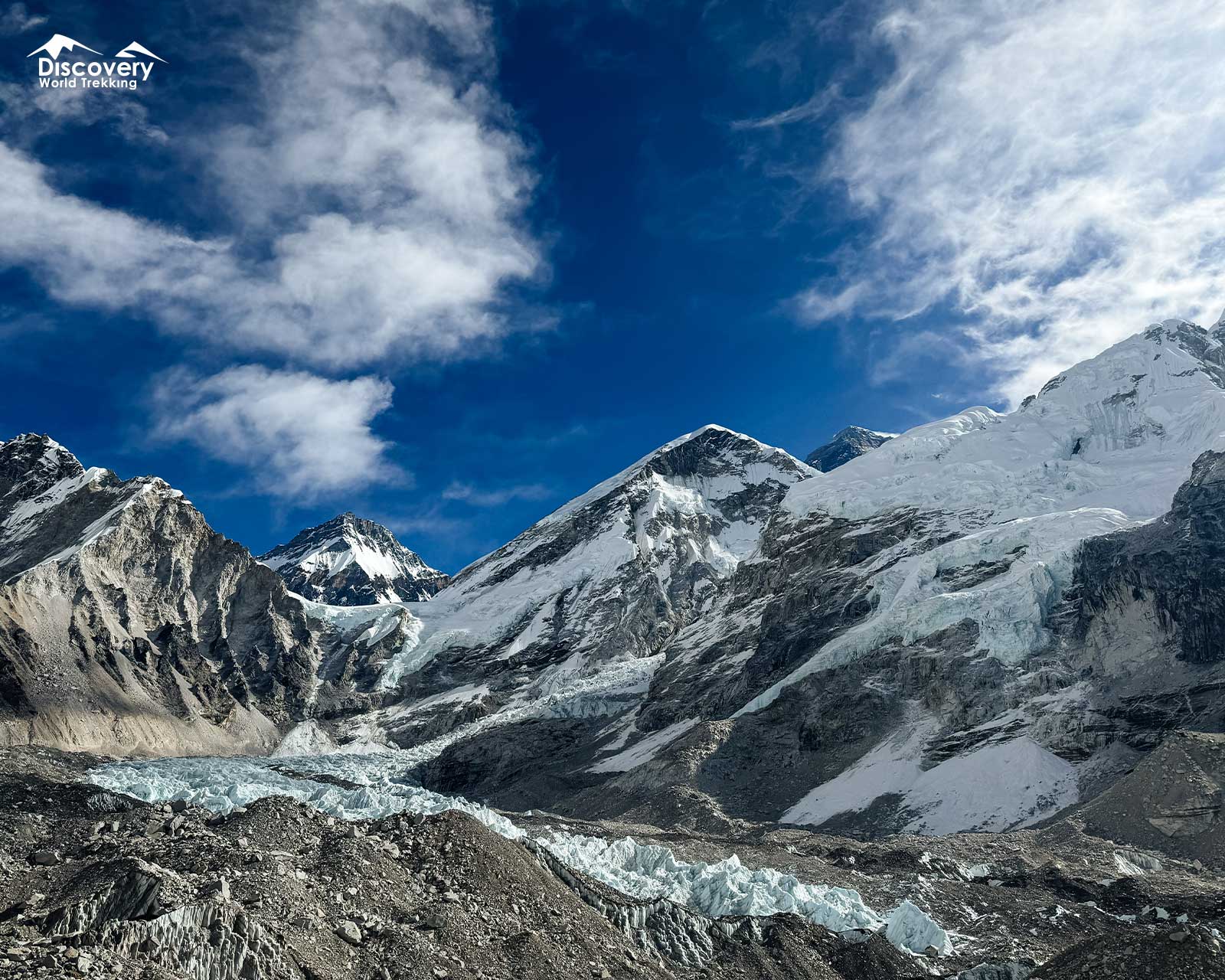
Everest Base Camp is located on the Khumbu Glacier. Its surface consists mainly of glacial moraine—a rough mixture of rocks, gravel, boulders, and ice carried by the slowly moving glacier. This creates a rugged landscape filled with icy ridges, crevasses, frozen pools, and piles of loose stone.
Why Is Everest Base Camp So Popular?
Everest Base Camp is a popular destination on the Everest Base Camp Trek for two main reasons:
1. Foot of the Roof of the World
Everest Base Camp lies beneath Mount Everest (Sagarmatha in Nepal), also known as the roof of the world. Everest is the highest point on Earth, rising to 8,848.48 metres, and its presence gives the entire area a powerful symbolic meaning.
For trekkers, reaching the base of the mountain represents getting as close as possible to one of the planet’s greatest natural landmarks.
2. First Successful Everest Summit
In 1953 A.D., when Sir Edmund Hillary and Tenzing Norgay Sherpa completed the ascent of Mount Everest, Everest Base Camp served as the staging area in this successful expedition.
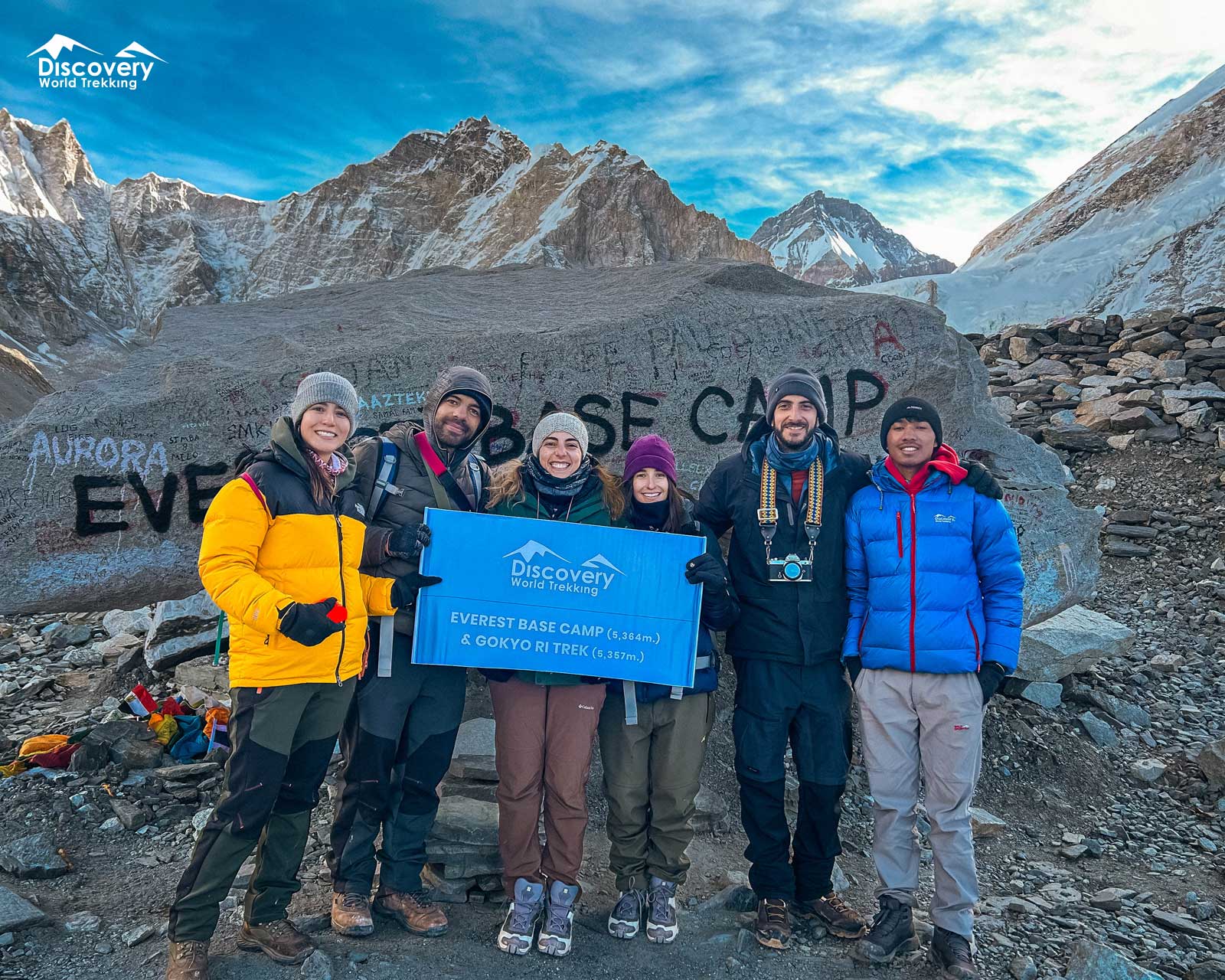
Iconic Rock at the Everest Base Camp
The iconic rock at Everest Base Camp is one of the most recognizable landmarks in the Everest region. It is painted with the words “Everest Base Camp” and its elevation of 5,364 metres.
This rock is the most photographed landmark at the base camp. Trekkers traditionally pose beside, behind, in front of, or on top of the rock to celebrate their successful ascent.
How to Reach Everest Base Camp?
Getting to EBC starts with a 20–40 minute flight from Kathmandu (or, from Manthali during peak season) to Lukla's Tenzing-Hillary Airport. After arriving in Lukla, the rest of the standard route is completed on foot.
The standard route follows:
- Lukla: 2,845 m (9,334 ft)
- Phakding: 2,650 m (8,563 ft)
- Namche Bazaar: 3,440 m (11,286 ft)
- Tengboche: 3,867 m (12,687 ft)
- Dingboche: 4,410 m (14,470 ft)
- Lobuche: 4,940 m (16,210 ft)
- Gorakshep: 5,164 m (16,942 ft)
- Everest Base Camp: 5,364 m (17,598 ft)
Alternatives to the standard route:
- By road via Jiri or Phaplu: For trekkers who would skip the Lukla flight. Skip the Lukla flight and start the trek from Jiri or Phaplu, adding 3 to 6 days to the journey.
Which Mountain Can You See From Everest Base Camp?
Everest Base Camp does not provide a complete view of Mount Everest’s summit. The summit is blocked by the massive wall of Nuptse when viewed from Base Camp.
Apart from Everest, there are several impressive mountains you can see from Base Camp:
- Nuptse (7,861 m): It can be seen directly above Everest Base Camp, forming the mountain wall behind the camp.
- Lhotse (8,516 m): The world's fourth-highest peak, it can be seen rising just beside Nuptse, connected to Everest by the South Col.
- Pumori (7,161 m): It can be seen to the northwest, forming the peak that Kala Patthar sits below on its southern ridge.
- Ama Dablam and Thamserku: These can be seen further down the valley to the south, visible on a clear day looking back the way you came.
Note: For a view of Everest's actual summit, trekkers continue to Kala Patthar, a separate viewpoint above Gorak Shep that most itineraries add on after visiting Base Camp.
Khumbu Glacier and Icefall
The Khumbu Glacier is the highest glacier in the world, running about 17 kilometres from the Western Cwm (a wide, bowl-shaped valley high on Everest's flank, sometimes called the "Valley of Silence") down past Base Camp toward Lobuche.
Everest Base Camp itself sits directly on this glacier's rocky, shifting moraine, which is part of why its exact position is not permanently fixed.
Khumbu Icefall
The Khumbu Icefall is the shattered, steep section of the glacier between about 5,486 m and 6,100 m, just above Base Camp. It is a constantly moving field of towering ice blocks (seracs) and deep crevasses.
It is the first major obstacle on the standard South Col route to Everest’s summit and is widely regarded as one of the most dangerous sections of the climb.
The ice here moves roughly 0.9 to 1.2 metres a day, which means the landscape literally reshapes itself between seasons.
Best Time to Visit Everest Base Camp
The two most popular trekking seasons are spring and autumn. However, Everest Base Camp can also be visited during winter and the monsoon season with proper planning.
1. Spring (March to May)
Spring brings relatively stable and gradually warmer weather to Everest Base Camp. Daytime conditions can feel comfortable under direct sunlight, but the temperature remains cold in shaded areas and drops below freezing at night.
Clear skies, good mountain visibility, and occasional snowfall are common, while strong winds and sudden weather changes may still occur because of the high altitude.
2. Autumn (September to November)
Autumn generally offers the clearest, driest, and most stable weather at Everest Base Camp. The skies are often deep blue, humidity is low, and the surrounding mountains and glaciers remain clearly visible.
Days can feel pleasant in the sunshine, but evenings and nights become very cold. As the season progresses, temperatures fall rapidly, and snowfall becomes more likely.
3. Winter (December to February)
Winter at Everest Base Camp is extremely cold, dry, and windy. Daytime temperatures often remain around or below freezing, while nighttime temperatures can fall far below freezing.
The skies are frequently clear, providing excellent mountain visibility, but powerful winds create severe wind-chill conditions. Snowstorms, drifting snow, and occasional whiteouts can also occur.
4. Summer/Monsoon (June to August)
Summer is the warmest but also the cloudiest and wettest season at Everest Base Camp. The area frequently experiences thick clouds, mist, rain, sleet, and wet snowfall.
Mountain visibility is often limited, especially during the afternoon, and the combination of moisture, wind, and low temperatures can make the conditions feel colder than expected. Clear views are possible, but they are usually brief and unpredictable.
Temperature at Everest Base Camp
| Season | Daytime | Nighttime |
| Spring (Mar–May) | -5°C to 5°C (23°F to 41°F) | -15°C to -8°C (5°F to 18°F) |
| Autumn (Sep–Nov) | -5°C to 8°C (23°F to 46°F) | -15°C to -5°C (5°F to 23°F) |
| Winter (Dec–Feb) | -15°C to -5°C (5°F to 23°F) | -25°C to -15°C (-13°F to 5°F) |
| Monsoon (Jun–Aug) | 0°C to 10°C (32°F to 50°F) | -5°C to 0°C (23°F to 32°F) |
How Hard Is It to Trek from Gorak Shep to EBC?
The trek from Gorak Shep to Everest Base Camp is moderately difficult.
Although the distance is relatively short, the thin air at more than 5,000 metres makes walking slower and more tiring than it would be at lower elevations.
The route covers approximately 3.5 to 4 kilometres each way and usually takes around two to three hours to reach Everest Base Camp.
The return journey to Gorak Shep may take another two hours, depending on the trekker’s fitness, acclimatization, weather, and trail conditions.
The trail follows the rocky moraine of the Khumbu Glacier. Trekkers must walk over loose stones, uneven ground, and occasional icy or snow-covered sections.
There are also several short ascents and descents along the route. However, the trail does not normally require ropes, climbing equipment, or technical mountaineering experience.
At over 5,000 metres altitude, trekkers may experience shortness of breath, headaches, tiredness, or reduced walking speed.
How Fit Do You Need to Be to Reach EBC?
You should be able to walk 3 to 8 hours a day on uneven trails for several consecutive days without feeling physically exhausted. What you need is the stamina to walk for several days at high altitude.
A few months of preparation can make a big difference. As for training, you can start about 8 to 12 weeks before departure, or 12 to 16 weeks if you are building your fitness from scratch.
These are some of the recommended training schedules:
- 12–16 weeks before: Build a basic walking habit and general fitness.
- 8–12 weeks before: Add uphill walking, stair climbing, and leg strength training (squats, lunges, step-ups).
- 4–8 weeks before: Increase to longer hikes and start training with a loaded daypack, building from 2–3 kg up to the roughly 5 kg you'll typically carry on the trail.
- 1–2 weeks before: Ease off intensity, stretch, rest, and stay healthy rather than trying to squeeze in one last hard session.
What Permits Are Required to Reach Everest Base Camp?
Two permits are required for the standard route, both tied to travel through Sagarmatha National Park and the surrounding municipality.
| Permit | Cost |
| Sagarmatha National Park entry permit | NPR 3,000 |
| Khumbu Pasang Lhamu Rural Municipality Permit | NPR 3,000 |
What do you need to pack?
A well-planned packing list can make your trek more comfortable and enjoyable. Below is a list of some of the essential items you should pack.
Bags and Gear
- Duffle Bag / Rucksack (50–60L): For Main clothing, sleeping gear, and spare items
- Daypack (20–30L): For carrying your daily water, camera, and documents while walking.
- Backpack Rain Cover: Keeps your daypack dry.
- Sleeping Bag: Rated down to -10°C to -15°C for cold mountain nights.
- Headlamp with spare batteries: For early morning starts.
- Trekking Poles: To ease pressure on your knees.
Clothing and Layers
- Trekking Boots: Sturdy boots with good ankle support.
- Base Layers: Moisture-wicking thermal tops and bottoms.
- Trekking Pants: Lightweight and quick-drying trousers.
- Insulating Layers: A warm fleece jacket and a down jacket rated for cold high altitudes.
- Outer Shell: Waterproof and windproof jacket and pants.
- Socks and Underwear: Several pairs of regular hiking socks, thermal socks, and breathable underwear.
Head and Face Protection
- Sun Hat and Beanie: One sun cap for daytime rays and a warm beanie for cold nights.
- UV-Protection Sunglasses: To prevent glare and snow blindness.
- Buff / Neck Gaiter: To block dust, sun, and cold wind.
- High-SPF Sunscreen and Lip Balm: Essential for intense high-altitude sun.
For a detailed packing list, download our Everest Base Camp Trek Checklist.
Is Visiting Everest Base Camp Worth It?
Everest Base Camp is widely considered worth it, and for a good reason. This trek provides the most stunning views of the Himalayas that can be experienced; it takes travelers through actual Sherpa villages and culture, and leaves you with a sense of pride in what you have achieved.
It is a tough trail, and therefore, preparations matter. But for trekkers who are well trained and prepared and follow all the necessary precautions, the Everest Base Camp is sure to offer them everything that it promises to offer: an unforgettable journey to the foot of the world's highest mountain.
FAQs
Is Mount Everest visible from Everest Base Camp?
No. Nuptse blocks the summit from this angle. For a clear view of Everest, trekkers continue on to Kala Patthar.
What is the Everest Base Camp Elevation?
The Everest Base Camp sits at an elevation of 5364m above sea level.
Do you need travel insurance for visiting Everest Base Camp?
Yes. The travel insurance needs to specifically cover high-altitude trekking and emergency helicopter evacuation, generally up to at least 6,000 metres. Standard travel insurance policies often exclude high-altitude activity above a much lower threshold, so check the fine print before buying.
Where to stay in Everest Base Camp?
There are no lodges that sit directly at Everest Base Camp itself. Trekkers heading to Everest Base Camp stay overnight at Gorakshep.
Plan Smarter, Trek Better
Connect with our local expert for honest recommendations, personalised guidance, and insider tips to make every step of your adventure count.

Get our free Nepal travel guide filled with expert insights, local tips, and essential planning advice.