


Kala Patthar: Best Viewpoint on Everest Region
Table of Contents
Kala Patthar is one of the most sought-after viewpoints in the Everest region of Nepal. For many trekkers, Everest Base Camp is the achievement that proves they made it to the base of Mount Everest. But Kala Patthar is the place that offers an actual close-up view of Mount Everest.
Where Is Kala Patthar Located?
Kala Patthar sits on the southern ridge of Pumori (7,161 m), just above the village of Gorak Shep in Nepal’s Khumbu region. It is about 1.5–2 km from Gorak Shep.
Pumori is a beautiful pyramid-shaped mountain on the western side of the Everest group, and Kala Patthar is part of its lower rocky slope. Kala Patthar forms part of the southern ridge of Pumori.
The viewpoint lies inside Sagarmatha National Park, a UNESCO World Heritage Site, at coordinates 27°59.750′N, 86°49.705′E.
| Location Detail | Information |
| Province | Koshi Province (formerly Province No. 1) |
| District | Solukhumbu District |
| Municipality | Khumbu Pasang Lhamu Rural Municipality |
| Region | Khumbu (Everest Region) |
| Latitude | 27°59.750′ N (≈ 27.9958° N) |
| Longitude | 86°49.705′ E (≈ 86.8284° E) |
| Elevation | Around 5,545 m to 5,644 m |
What Does “Kala Patthar” Mean?
Kala Patthar means "Black Rock" in Nepali. This ridge is made of dark, exposed rock that stays black, brown, or charcoal-grey even when the surrounding peaks are covered in snow.
How High Is Kala Patthar?
Kala Patthar sits at approximately 5,545 metres (18,192 feet). At this height, Kala Patthar stands roughly 181 metres above Everest Base Camp (5,364 m).
Why Hike Kala Patthar After Everest Base Camp?
Everest Base Camp brings you to the foot of Mount Everest, but it does not provide a clear view of the summit.
Nuptse lies directly in the sightline from Base Camp and blocks much of Everest’s upper profile. But Kala Patthar rises above that obstruction.
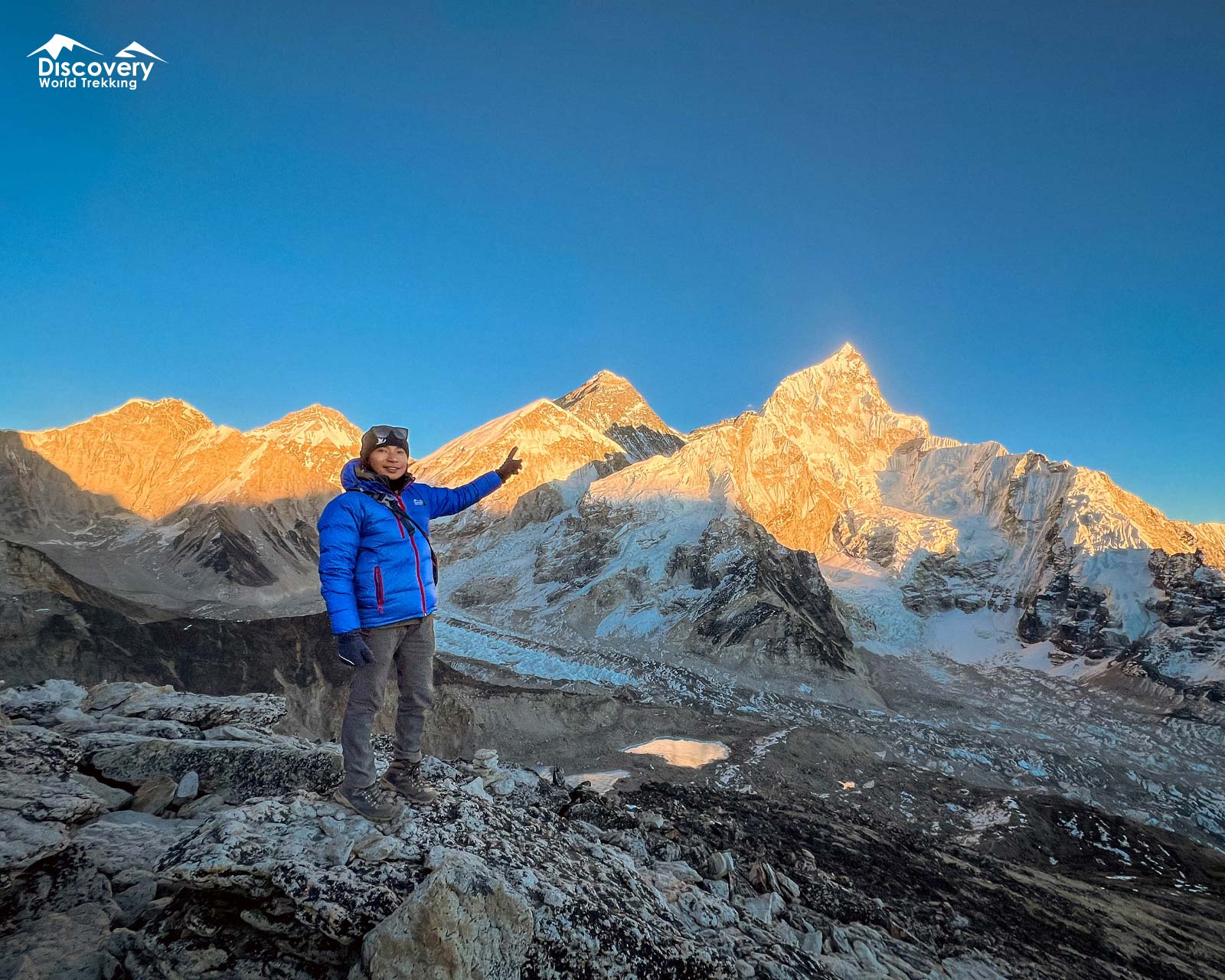
From the ridge, Everest’s summit and south-west face become clearly visible, with Lhotse and Nuptse nearby and Pumori rising behind the viewpoint.
What Can You See From Kala Patthar?
- Mount Everest (8,848.86 m / 29,031.7 ft): The main highlight, offering a clear view of the summit, South Summit, Southeast Ridge and parts of the South Col route.
- Lhotse (8,516 m / 27,940 ft) and Nuptse (7,861 m / 25,791 ft): These neighbouring peaks frame Everest and dominate the surrounding skyline.
- Pumori (7,161 m / 23,494 ft): This pyramid-shaped peak rises immediately behind the viewpoint and appears especially close.
- Khumbu Glacier and Khumbu Icefall: Located below the viewpoint, the glacier and Icefall are easy to see, with their large blocks of ice and deep cracks.
- Ama Dablam (6,812 m / 22,349 ft): This distinctive peak is visible to the south-east on clear days.
Is Sunrise or Sunset Better at Kala Patthar?
Both sunrise and sunset offer excellent views from Kala Patthar.
Sunrise
Sunrise is the most popular time to visit. Trekkers usually leave Gorak Shep around 4:45 a.m. and hike with headlamps to reach the viewpoint before dawn.
The skies are often clearest in the early morning, and the first rays of sunlight cast a golden glow over Mount Everest, Lhotse, and Nuptse.

Sunset
Sunset is usually quieter because fewer trekkers make the climb in the evening. The warm evening light creates beautiful views and is ideal for photography, especially when Everest casts its shadow across the surrounding landscape.
However, clouds are more common in the afternoon, so visibility is not always as clear as it is at sunrise.
Note: If you only have time for one visit, sunrise is generally the better choice because it usually offers clearer skies and the best chance of seeing Mount Everest.
How to Reach Kala Patthar?
Most visitors hike to Kala Patthar as part of the classic Everest Base Camp Trek, following this route:
Kathmandu → Lukla → Phakding → Namche Bazaar → Tengboche → Dingboche → Lobuche → Gorak Shep → Everest Base Camp → Gorak Shep → Kala Patthar
The journey starts with a flight from Kathmandu to Lukla (2,860 m), the gateway to the Khumbu. From Lukla, you walk through Phakding and Monjo, where you enter Sagarmatha National Park and then climb up to Namche Bazaar.
From Namche Bazaar, the trail continues to Tengboche, then to Dingboche. After that comes Lobuche, and finally Gorak Shep, the last settlement on the trail, and the starting point for both Everest Base Camp and Kala Patthar.
Can Helicopters Land at Kala Patthar?
No. Helicopters are no longer permitted to land at Kala Patthar.
As per the rules imposed by the Civil Aviation Authority of Nepal (CAAN) and Sagarmatha National Park, commercial helicopter tours may take flight above Kala Patthar and Everest Base Camp but are prohibited from landing there.
Such restrictions help improve safety at high altitude and protect the fragile alpine environment.
Today, most Everest helicopter tours land at Hotel Everest View near Syangboche, where visitors can enjoy panoramic views of Mount Everest and the surrounding Himalayan peaks before returning by helicopter.
When Is the Best Time to Visit Kala Patthar?
Spring (March to May) and autumn (September to November) are the most reliable seasons. Both offer stable weather, clearer skies, and the strongest visibility of Everest and the surrounding peaks.
| Season | Weather | Description | Typical Temperature |
| Spring (March–May) | Cold mornings with mild daytime temperatures and stable weather | One of the best seasons to visit, with clear skies, excellent mountain views, and stable hiking conditions. | Day: -5 to 8°C (23 to 46°F) Night: -18 to -5°C (0 to 23°F) |
| Summer/Monsoon (June–August) | Frequent rain at lower elevations with cloudy conditions | Slippery trails, possible flight delays, and limited mountain views due to clouds and rain. | Day: 0 to 10°C (32 to 50°F) Night: -10 to 0°C (14 to 32°F) |
| Autumn (September–November) | Cold, dry, and stable weather | The best season for visiting Kala Patthar, offering clear skies, excellent visibility, and ideal hiking conditions. | Day: -5 to 5°C (23 to 41°F) Night: -20 to -8°C (-4 to 18°F) |
| Winter (December–February) | Very cold with occasional snowfall and strong winds | Suitable for experienced trekkers prepared for freezing temperatures, icy trails, and possible snowfall. Clear days still offer excellent mountain views. | Day: -15 to 0°C (5 to 32°F) Night: -25 to -10°C (-13 to 14°F) |
How Difficult Is the Hike to Kala Patthar?
The hike is moderately difficult to challenging. It requires no ropes, climbing equipment, or mountaineering experience, but the high altitude, steep trail, and cold conditions make it demanding.
Oxygen levels at this height are roughly half of what they are at sea level, which slows pace, increases fatigue, and makes even a short, steep climb feel far harder than the distance suggests.
Most trekkers who follow a proper acclimatisation schedule, including rest days in Namche Bazaar and Dingboche, can complete the hike.
Anyone who develops symptoms of altitude illness should not continue to Kala Patthar and should descend if the symptoms worsen.
How Long Does It Take to Hike Kala Patthar?
It takes about 1 to 1.5 hours to climb from Gorak Shep to the viewpoint, covering roughly 400 metres of elevation gain over about 2 kilometres. The descent is faster, usually 30 to 40 minutes.
Do You Need a Permit to Visit Kala Patthar?
Trekkers generally need a Sagarmatha National Park entry permit and a Khumbu Pasang Lhamu Rural Municipality Trek-Card to visit Kala Patthar.
| Permit | Fee (foreign nationals) |
| Sagarmatha National Park Entry Permit | NPR 3,000 |
| Khumbu Pasang Lhamu Rural Municipality Permit | NPR 3,000 |
Where Do You Stay Before Visiting Kala Patthar?
Gorak Shep is the overnight base for both Everest Base Camp and Kala Patthar. It is the only settlement close enough to reach either on foot in a single push.
Facilities are basic. Teahouses usually offer simple twin-share rooms that are unheated, while the communal dining area may be warmed by a yak-dung stove.
Shared toilets are common, while hot showers, Wi-Fi and device charging may be limited and usually cost extra.
How Is Kala Patthar Different From Other Everest Region Viewpoints?
Kala Patthar is not the only viewpoint in the Everest region, but it stands out for how directly it serves the classic trek.
Kala Patthar vs Everest Base Camp
Everest Base Camp is about standing at the foot of Everest and connecting with its expedition history. Kala Patthar is about actually seeing Everest well. Base Camp gives atmosphere and achievement. Kala Patthar gives the classic mountain panorama.
Kala Patthar vs Gokyo Ri
Gokyo Ri offers a broader and often quieter panoramic experience, with lakes and wider scenery adding a different type of beauty. But Everest appears more distant there. Kala Patthar feels closer, more direct, and more emotionally tied to the Everest Base Camp journey.
Kala Patthar vs Everest View Hotel
Everest View Hotel is much easier to access and suits travelers who want a distant Everest view without going deep into extreme altitude. Kala Patthar is far more dramatic and close-up, but it demands much more effort and acclimatization.
Kala Patthar vs Chhukung Ri
Chhukung Ri offers a different angle and can appeal strongly to trekkers doing extended or more adventurous Everest-region routes. It is quieter and unique, but for the classic, front-facing Everest moment on the standard trek, Kala Patthar remains the stronger fit.
| Viewpoint | Elevation | Everest View | Best For |
| Kala Patthar | 5,545 m | Full summit, unobstructed | Closest, most iconic view on the classic EBC route |
| Everest Base Camp | 5,364 m | Summit blocked by Nuptse | Atmosphere and trekking history, not the view |
| Gokyo Ri | 5,357 m | Everest visible but more distant | Panoramic views with turquoise lakes, fewer crowds |
| Chhukung Ri | 5,546 m | Different angle, Lhotse and Makalu | Trekkers on extended or Three Passes routes |
| Everest View Hotel | 3,880 m | Distant but clear | Easy access without deep trekking or altitude risk |
Can Beginners Go to Kala Patthar?
Yes, beginners can hike to Kala Patthar with the right preparation.
What matters more than experience is fitness and acclimatization.
Beginners who trek at a steady pace and take the rest days at Namche Bazaar and Dingboche seriously can manage the hike without major difficulty.
What Should I Pack for Visiting Kala Patthar?
- Layered clothing: a thermal base layer, insulating fleece or down mid-layer, and a windproof outer shell. Temperatures swing sharply between the pre-dawn start and the walk back down, so layers let you adjust as you warm up or cool off.
- Warm accessories: insulated gloves, a warm hat, and a neck gaiter or buff. Wind chill at this altitude bites at exposed skin faster than the air temperature alone suggests.
- Headlamp with spare batteries: needed for the pre-dawn start, since most of the climb happens before sunrise in the dark. Cold drains batteries faster than usual, so carry a backup set.
- Trekking poles: help with balance on the loose, rocky trail, especially on the descent when legs are tired, and footing gets less sure.
- Sunglasses (UV400) and sunblock: glare off snow and ice is intense even in freezing conditions, and unprotected eyes and skin burn quickly at this altitude.
- Water and snacks: Since there is nowhere to refill or buy food at the summit itself.
Safety & Travel Tips for Hiking Kala Patthar
The main risk at Kala Patthar is not the rocky trail but the altitude.
At over 5,500 metres, oxygen availability is roughly half of sea-level conditions, and altitude sickness can affect fit, experienced trekkers just as easily as beginners.
As a trekker, it is essential to watch out for these symptoms: headache, nausea, dizziness, unusual fatigue, and loss of appetite.
These typically appear gradually and respond to rest. More serious warning signs include confusion, loss of coordination, coughing up pink froth, or blue-tinged lips.
These require immediate descent and medical attention, since they can indicate HAPE or HACE, both life-threatening.
To reduce risk, it is essential that you:
- Take the scheduled acclimatization days at Namche Bazaar and Dingboche seriously; do not skip or shorten them.
- Drink 3–4 litres of water daily and avoid alcohol, which worsens dehydration at altitude.
- Ascend at a steady pace; rushing the final climb to Kala Patthar increases symptoms more than the distance would suggest.
- Descend and do not continue upward hoping they will pass if symptoms worsen rather than improve with rest.
A licensed guide adds real value here, both for pacing and for making the call to turn back if conditions or symptoms demand it. As weather at this altitude can shift quickly, it is essential to treat the summit as a place to visit briefly, not to wait around in.
FAQs
What is the altitude of Kala Patthar?
Kala Patthar sits at approximately 5,545 meters ( 18,192 feet ), roughly 191 meters above Everest Base Camp
Is Kala Patthar the best place to see Mount Everest?
On the classic Everest Base Camp trek, yes, it is the closest ground-level point with an unobstructed view of the Everest summit. Base camp itself is blocked by Nuptse
Do you need acclimation before hiking Kala Patthar?
Yes, proper acclimation through the standard rest days at Namche Bazaar and Dingboche is essential before attempting the climb, regardless of fitness level
Is Kala Patthar harder than Everest Base Camp?
Yes. From Gorak Shep, the climb to Kala Patthar is steeper and reaches a higher altitude than the walk to Base Camp, even though Base Camp itself covers the longer distance earlier in the day.
Can Beginners Hike Kala Patthar?
Yes, beginners can hike Kala Patthar if they follow a proper acclimatization schedule and are reasonably fit. The trail itself requires no technical skill; altitude is the main challenge, not terrain.
Plan Smarter, Trek Better
Connect with our local expert for honest recommendations, personalised guidance, and insider tips to make every step of your adventure count.

Get our free Nepal travel guide filled with expert insights, local tips, and essential planning advice.