

Lobuche
Table of Contents
Lobuche is a small high-altitude settlement in the Khumbu region of Nepal. It is one of the last major overnight stops on the Everest Base Camp Trek. It is an important rest point for trekkers heading to Everest Base Camp, Kala Patthar, and Lobuche Peak.
Where is Lobuche Located?
Lobuche is located in the Khumbu Pasang Lhamu Rural Municipality of Solukhumbu District in Koshi Province, northeastern Nepal.
It lies in the upper Khumbu (Everest) region at an elevation of approximately 4,940 metres (16,207 feet).
It stands beside the Khumbu Glacier inside the Sagarmatha National Park.
The village is situated about 8.5 km north of Dingboche and 4.5 km south of Gorak Shep. It sits less than 2–3 kilometers northeast of the Thukla Pass Memorial.
| Location Detail | Information |
| Country | Nepal |
| Province | Koshi Province |
| District | Solukhumbu District |
| Municipality | Khumbu Pasang Lhamu Rural Municipality |
| Region | Khumbu (Everest Region) |
| Latitude | 27.9500° N |
| Longitude | 86.8130° E |
| Elevation | 4,940 m (16,207 ft) |
How to Reach Lobuche?
You do not arrive in Lobuche by bus, jeep, or private car. You reach it on foot. The journey begins far below the location, starting from a short flight to Lukla from Kathmandu/Manthali.
If you are heading on the Everest Base Camp Trail, you will reach Lobuche after ascending from Dingboche.
The standard route follows:
→ Kathmandu/Manthali
→ Lukla (40 min flight from Kathmandu or 20 min from Manthali)
→ Phakding (3 hrs)
→ Namche Bazaar (6 hrs)
→ Tengboche/Deboche (5 hrs)
→ Dingboche (5 hrs)
→ Lobuche (5 hrs)
Do You Need Permits to Visit Lobuche?
Trekkers visiting Lobuche must obtain the following permits:
| Permit | Required For | Permit Cost |
| Sagarmatha National Park Entry Permit | Required to enter Sagarmatha National Park. | NPR 3,000 |
| Khumbu Pasang Lhamu Rural Municipality Permit | Required to enter the Khumbu region and supports local infrastructure, tourism management, and conservation efforts. | NPR 3,000 |
Note: A TIMS Card is not required for the Everest Base Camp Trek. If you plan to climb Lobuche Peak, a separate climbing permit issued by the Nepal Mountaineering Association is mandatory.
Best Time to Visit Lobuche
The best time to visit Lobuche is during the months of spring (March – May) and autumn (September – November).
1. Spring (March – May)
Spring is one of the best seasons to visit Lobuche. The spring season usually starts after the winter season in Nepal.
After the cold winter, the temperature slowly begins to rise, and the sky becomes clear. The temperature is ideal for trekking in the daytime.
Although Lobuche sits at a high altitude, with the right guidance, you can enjoy clear mountain views with less clouds in the morning.
2. Summer / Monsoon (June – August)
In Nepal, summer and monsoon season arrives around the same time.
As Lobuche stands at a high altitude, the daytime summer temperature is warm and comfortable when the sun is shining brightly. However, during monsoon time, the village may experience light rain, mist, and snow showers.
Lobuche gets less total volume of water than lower villages like Namche Bazaar because it sits higher up and near a partial rain shadow zone. Frequent afternoon clouds, fog, and damp drizzle are common in the area.
3. Autumn (September – November)
If you want to experience the best crystal-clear views of the Everest mountain range from Lobuche, autumn is the best choice.
As the season starts after the rainy season, the chances of rain is very low in autumn. Already Lobuche receives less rain even during monsoon season, the chances of cloud formation in daytime is very low. So, there is low-to-no obstruction in visibility.
4. Winter (December – February)
Lobuche already sits at a high altitude. The temperature gets very low as the season progresses. Although the views of mountains covered in thick snow is mesmerizing, you need to be well-prepared if you want to spend your day in Lobuche.
Where is Lobuche Peak from Lobuche?
Lobuche Peak rises immediately west–northwest of Lobuche, on the opposite side of the valley from the Khumbu Glacier.
Lobuche Peak has two distinct summits, Lobuche East (6,119 m) and Lobuche West (6,145 m), which are about 2 km apart and separated by a steep, deeply notched ridge.
Lobuche East Peak stands west-northwest of Lobuche, while the more technical Lobuche West lies farther northwest along the same massif.
It is approximately 3 kilometres from the area in a straight line, but rises nearly 1,180 metres above it.
Trekkers heading to Lobuche Peak leave the main Everest Base Camp trail and follow a separate uphill route towards Lobuche Base Camp and High Camp to summit the peak.
If you are heading towards Gorak Shep and Everest Base Camp, you will continue north along the main trail. You will not pass over Lobuche Peak.
Things to Do around Lobuche
Here are some of the activities that one can enjoy in the place:
1. Visit the World’s Highest Bakery & Café
Located in Lobuche, the World’s Highest Bakery & Café is a well-known stop for trekkers on the Everest Base Camp trail. It serves hot drinks, baked goods, and simple snacks, and is often cited as one of the highest bakeries in the world.
2. View the Italian Pyramid Laboratory
The Italian Pyramid Laboratory is a scientific research facility situated at an altitude of 5,050 m (16,568 ft). It sits 1.2 kilometers (about 0.75 miles) north of the main Lobuche.
It was founded in 1990 and carries out studies on climate change, glaciers, and mountain science. Though it does not welcome visitors, its unique pyramid-like architecture can be spotted from the path.
3. Experiencing Khumbu Glacier and Himalayas
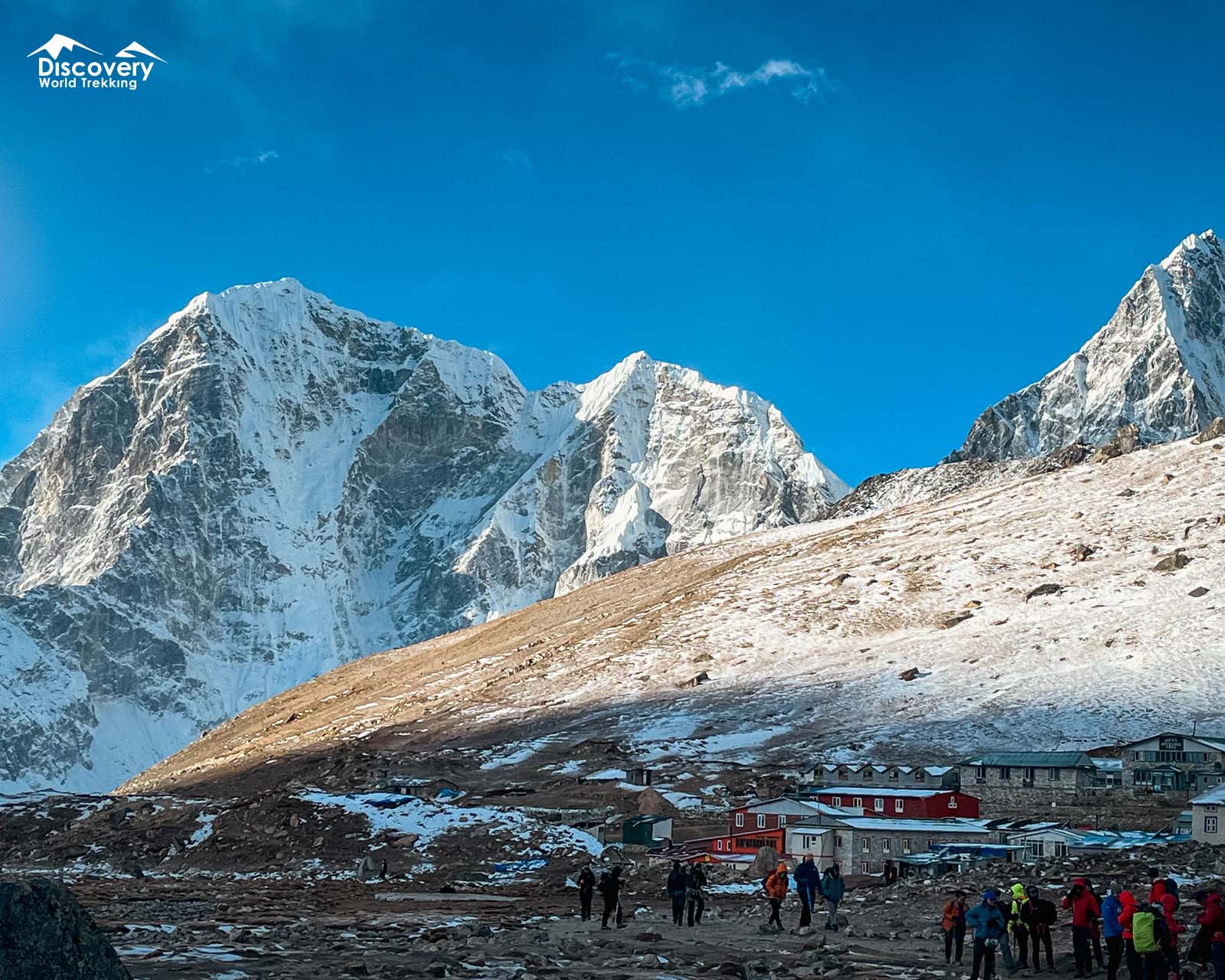
The town of Lobuche is located by the side of the Khumbu Glacier, and provides scenic views of the rock moraine, ice structures, and Himalayan mountains. The sunrise and sunset offer ideal light for photographing the Himalayan scenery.
4. Go Stargazing
With almost no light pollution in Lobuche, it is a great place to go stargazing. During clear nights, one can see the Milky Way and thousands of stars.
5. Visit the Thukla Pass Memorial
The Thukla Pass Memorial is one of the most meaningful stops near Lobuche. It stands on the windswept ridge of Chupki Lhara, above the small settlement of Thukla, along the trail from Dingboche to Lobuche.
The site is not one large monument. It contains numerous stone cairns. Families, Sherpa communities and expedition teams built them in memory of climbers and mountain workers who died on Everest and nearby Himalayan peaks.
History of Lobuche
Before trekking tourism developed, the Lobuche area was mainly used for seasonal yak grazing by the nearby Sherpa community living in lower altitudes. It was mostly used in warmer seasons.
After the first confirmed ascent of Mount Everest by Tenzing Norgay and Edmund Hillary in 1953, Lobuche became a crucial stop at the Everest expedition trail.
As international expeditions increased, more climbers, porters, guides and supply animals began travelling through the Lobuche Valley toward Everest Base Camp.
Gradually, basic stone shelters developed into teahouses and trekking lodges.
Accommodation and Food in Lobuche
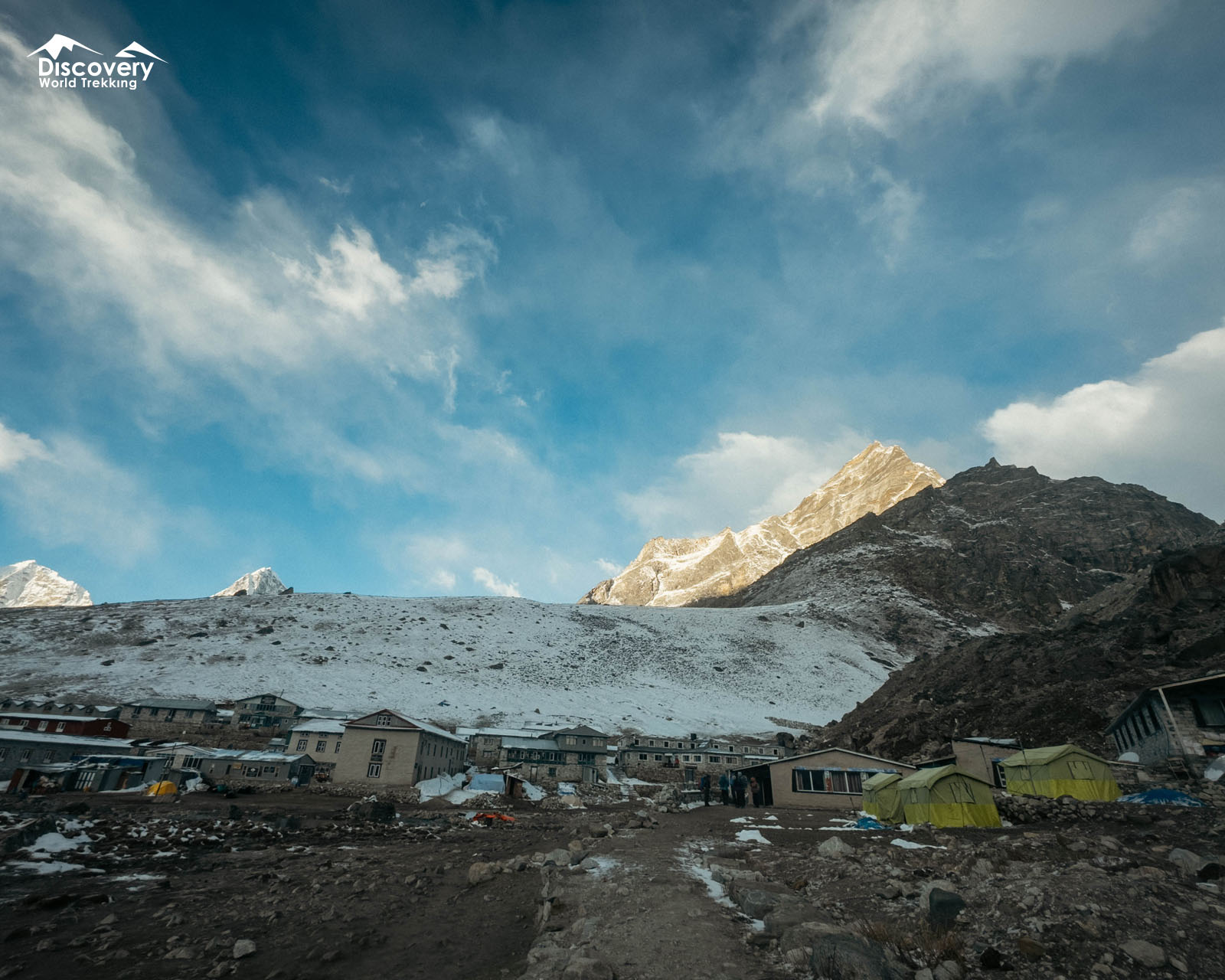
Although situated in a remote area, Lobuche has quite a few basic teahouses and lodging places that offer accommodation to the trekkers. Lobuche has around 8–10 teahouses and lodges during the main trekking seasons.
Rooms are basic but comfortable enough for an overnight stay.
Typical accommodation features include:
- Twin-sharing rooms with beds, mattresses, pillows, and blankets
- Unheated bedrooms; only the communal dining hall is heated
- Shared bathrooms are standard
- Mostly squat toilets, with limited Western-style toilets
Food and Drinks Available in Lobuche
Most lodges serve a standard teahouse menu with both Nepali and international dishes. Popular meals include:
- Dal Bhat (rice, lentils, and vegetables)
- Fried rice
- Noodle soups
- Momos
- Sherpa stew
- Garlic soup
- Pizza and pasta
- Porridge, eggs, pancakes, and toast for breakfast
Fresh bread, pastries, and coffee are also available at the World's Highest Bakery & Café.
Facilities and Services
Although facilities are limited, most lodges provide basic services for trekkers.
| Facility | Availability |
| Electricity | Available through solar power or generators |
| Device Charging | Available for an additional fee |
| Wi-Fi | Available (Everest Link), but often slow and weather-dependent |
| Hot Shower | Available at some lodges for an additional charge |
Culture in Lobuche
In Lobuche, you will experience Sherpa culture, carried up from villages like Pangboche and Namche by the families who run local lodges here. The people follow Tibetan Buddhist traditions.
Flora and Fauna near Lobuche
The high altitude and cold weather in Lobuche have created an extremely tough environment, allowing for the survival of only a few species of plant and animal life.
Unlike the forests found lower in the Everest region, the landscape around Lobuche is mostly rocky, barren, and treeless.
Flora
Above 4,900 m (16,076 ft), trees are completely absent, being replaced by hardier alpine vegetation.
The flora of Sagarmatha National Park consists of:
- Mosses and lichens
- Dwarf rhododendron shrubs
- Small alpine wildflowers (during spring)
Fauna
Despite the unfriendly alpine climate of the region, Lobuche is the natural habitat of numerous animal species that have adapted to living in such extreme climatic conditions.
One of such species is blue sheep (bharal), along with Himalayan tahr, which are usually found in the nearby rocky areas. In addition, one can meet pikas and Himalayan marmots among the rocks and in alpine meadows.
Snow leopard is also a common inhabitant of the area; however, it is extremely difficult to see it there.
Among the birds, bearded vultures (lammergeiers) can be frequently observed flying from Dingboche to Lobuche, as well as yellow-billed choughs and snow pigeons near the hiking path and the village.
Popular Treks Passing Lobuche
Lobuche is an important stop on several trekking routes in the Everest region. Below are some of the most popular treks.
| Trek | Maximum Elevation | Description |
| Everest Base Camp Trek | 5,555 m (Kala Patthar) | Passes through Lobuche before continuing to Gorak Shep, Everest Base Camp, and Kala Patthar, the highest point of the trek. |
| Everest Base Camp Trek via Gokyo Lakes | 5,555 m (Kala Patthar) | Reaches Lobuche after crossing Cho La Pass (5,420 m) before continuing to Everest Base Camp and Kala Patthar. |
| Everest Three Passes Trek | 5,535 m (Kongma La Pass) | Passes through Lobuche between Cho La Pass and Kongma La Pass, completing one of the most challenging trekking circuits in the Everest region. |
| Everest Base Camp Short Trek | 5,555 m (Kala Patthar) | Follows the classic Everest Base Camp route in a short time span through Lobuche before continuing to Gorak Shep, Everest Base Camp, and Kala Patthar. |
Practical Travel Tips for Lobuche
Proper preparation is essential when visiting Lobuche. Its high altitude, cold temperatures, and limited facilities make careful planning very important for a safe and comfortable trek.
Pack the Right Gear
Carry warm, layered clothing and trekking equipment suitable for high-altitude conditions.
Essential items include:
- Four-season sleeping bag (rated to at least -15°C)
- Down or insulated jacket
- Waterproof and windproof jacket
- Thermal base layers
- Fleece mid-layer
- Insulated trekking pants
- Warm hat, gloves, and insulated mittens
- Waterproof trekking boots
- Trekking poles
- Headlamp with spare batteries
- Insulated water bottle
- Sunscreen, lip balm, and UV-protection sunglasses
- Personal first-aid kit and altitude sickness medication
Dress in Layers
Wear your clothing in layers to adapt to changing weather conditions throughout the day.
- Base Layer: Moisture-wicking thermal clothing
- Mid Layer: Fleece or light insulated jacket
- Outer Layer: Waterproof and windproof shell
- Insulation Layer: Down jacket for breaks and evenings
Tip: Start your hike slightly cool rather than overdressed. You'll warm up while walking, and avoiding sweat helps prevent you
Prevent Altitude Sickness
Altitude sickness is common in Lobuche due to its high elevation. It is therefore important that you climb slowly and drink enough water. Avoid alcohol and sleeping pills. In case of severe headaches, nausea, dizziness, unreasonable tiredness, sleepiness, and shortness of breath, even when resting, you should notify the guide and go back down.
FAQs
Is Lobuche suitable for beginner trekkers?
Yes, with proper preparation. It's physically demanding due to the altitude, but it doesn't require technical climbing skill, just good fitness and a sensible acclimatization schedule.
What's the nearest medical help to Lobuche?
The closest medical post is run by the Himalayan Rescue Association in Pheriche, which specifically treats altitude sickness cases. For serious emergencies, helicopter evacuation to Kathmandu is standard.
Can you see Mount Everest from Lobuche?
Yes, Mount Everest is visible from Lobuche, but only the upper slopes and summit ridge.
How cold does Lobuche get?
Daytime temperatures range from around 10°C in the best months down to well below -10°C at night during winter. Nights are cold year-round, even in spring and autumn.
Plan Smarter, Trek Better
Connect with our local expert for honest recommendations, personalised guidance, and insider tips to make every step of your adventure count.


Get our free Nepal travel guide filled with expert insights, local tips, and essential planning advice.